Private health insurance rebate for seniors:
estimate the impact of the proposed cut to the rebate
How much could the cut to Private Health Insurance rebates cost you?
The federal government has legislation before the Parliament to reduce the higher rebate for Private Health Insurance for people 65 and over to pay for aged care, from 1 April 2027.
The private health insurance rebate is a percentage of premiums that many people receive off their private health insurance premium bill.
Reducing the rebate could increase out-of-pocket premiums by more than $1000 a year for a couple with Gold cover and force tens of thousands of seniors to drop or downgrade their insurance.
The estimator below shows the likely impact on your current policy.
If this concerns you, support our advocacy against this proposal by joining our Health Costs campaign below.
Worried about how much your premiums might increase? Concerned about further demands being put on the public health system? Join our Health Costs campaign to help us advocate against this change:
- The legislation to make the announced change to the rebate has been introduced to the Parliament, but has yet to pass either the House of Representatives or the Senate. It is called the Private Health Insurance Amendment (Modernising the Private Health Insurance Rebate) Bill 2026. The next sitting fortnight starts on 11 August 2026.
- A Senate committee has commenced an inquiry into the Bill. The inquiry is accepting submissions until 21 August, you can read our Connect article about making a submission here. The inquiry is due to make its report by 7 October 2026.
The federal government provides a rebate for Private Health Insurance to reduce the cost of private health insurance.
This is one of several incentives and penalties used to maintain the number of people subscribed to private health insurance.
Many people receive this rebate directly off their premium, but some may receive it at tax time.
The rebate rate depends on the age of the people insured and their income.
Since 2004, people 65 year and over have received a higher level of rebate than people below this age.
The government has announced its intention to reduce this higher rebate for seniors to the level applying to those under age 65.
This is expected to increase premiums for the estimated 2.6 million seniors with Private Health Insurance cover, leading some to drop their cover - increasing the strain on the public health system.
The impact will be most significant for pensioners and low-income self-funded retirees, who will either drop or downgrade their policy or reduce spending on other essentials.
The table below shows the current rebate levels - if implemented, the likely rates are the ones in bold:
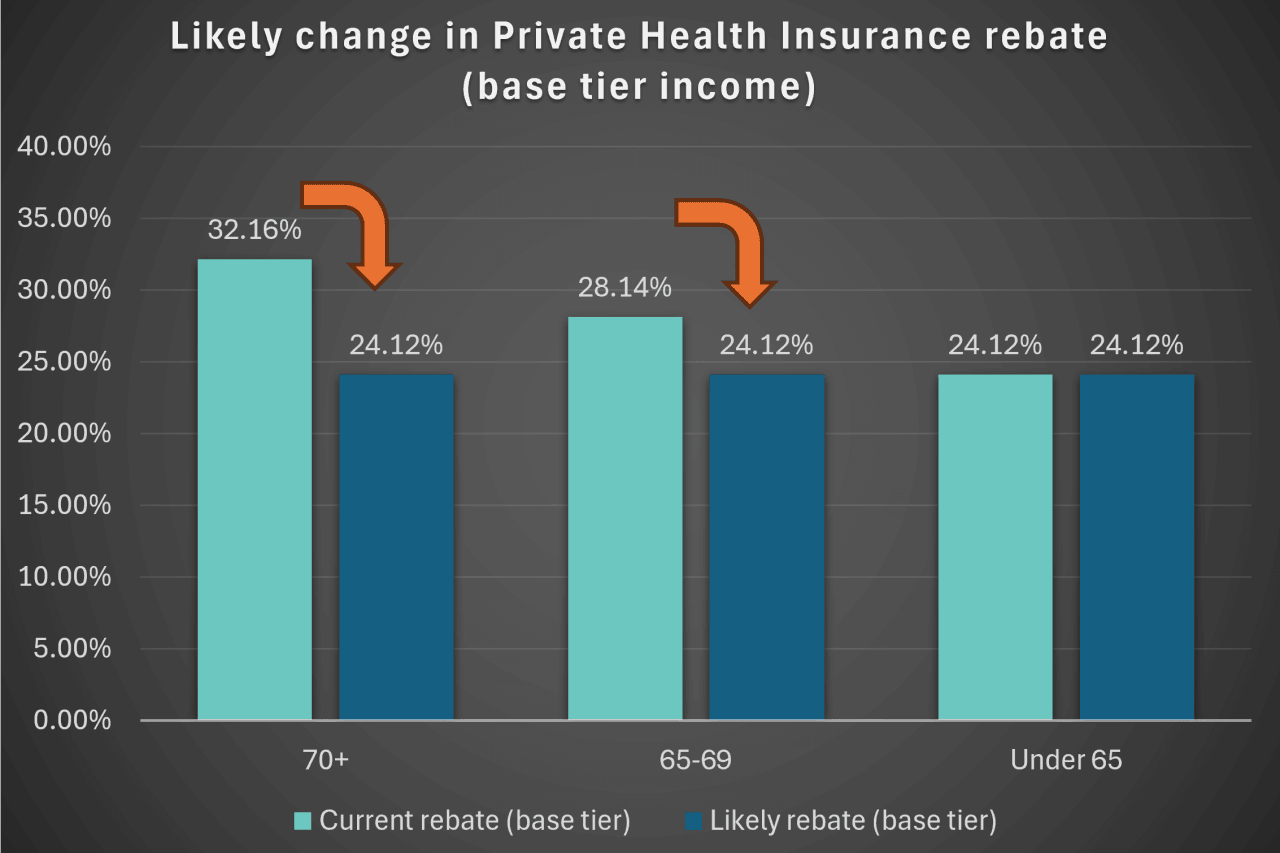
Private Health Insurance rebate, rates for July 2026 to March 2027
| Oldest person covered | Base tier | Tier 1 | Tier 2 | Tier 3 |
|---|---|---|---|---|
| Under 65 years old | 24.118% | 16.079% | 8.038% | 0.000% |
| 65–69 years old | 28.139% | 20.098% | 12.058% | 0.000% |
| 70 years old and over | 32.158% | 24.118% | 16.079% | 0.000% |
The Private Health Insurance rebate is subject to means testing based on income. The higher the income the less the rebate.
Note that the definitions of income and family status are specific. More detail about these definitions can be found on the ATO website here.
The rebate income thresholds are indexed each year. Note that the proposed rebate change would apply from 1 April 2027, ahead of the threshold indexation from 1 July 2027.
Private Health Insurance rebate income thresholds 2026/27
| Family status | Base tier | Tier 1 | Tier 2 | Tier 3 |
|---|---|---|---|---|
| Single | $105,000 or less | $105,001 – $123,000 | $123,001 – $164,000 | $164,001 or more |
| Family | $210,000 or less | $210,001 – $246,000 | $246,001 – $328,000 | $328,001 or more |
The above is based on the following assumptions:
- The measure is introduced as announced, based on publicly available information, starting 1 April 2027.
- Estimation does not include annual premium increasing applying on 1 April 2027.
- Estimation does not include annual decrease to rebate level based on relative premium and inflation changes.
- The rebate levels are not changed from those applying in April 2026.
- The income tiers are as 1 July 2026 and do not reflect 1 July 2027 indexation.
The information on this page are general estimates of the potential impact based on the information available and assumptions made and is intended as educational material and not legal advice, financial advice, or other forms of professional advice. The impact will vary depending on the full financial circumstances of specific individuals or couples.
Members save 10% on Travel Insurance*
National Seniors members receive a 10% discount on travel insurance policies*.
Thousands of Australia-wide discounts
Exclusive offers and savings across dining, shopping, gift cards, and more – all in the EAT | PLAY | SAVE app.

Financial Information Consultant
Speak to a real person and receive up-to-date information on retirement planning, superannuation, and more!

Branches
Expand your social circle, enjoy social events, day trips, guest speakers, and meet like-minded members.

Exclusive Travel Discounts
Save on tours, cruises, and holidays with exclusive discounts on National Seniors Travel.

Our Generation Digital Magazine
Receive a yearly subscription to Our Generation Digital Magazine.
Advocacy & Research
Your membership directly funds our advocacy and research work fighting issues that affect you.

Competitions
Access exclusive member-only weekly competitions including books, DVDs, CDs, movie tickets and more.

Discounts
In addition to the discounts app, members can save thousands on eGift Cards and other discounted products.
*The discount applies to the total National Seniors travel insurance premium and is for National Seniors Australia members only. Discounts do not apply to the rate of GST and stamp duty or any changes you make to the policy. AGA has the discretion to withdraw or amend this discount offer at any time. This discount cannot be used in conjunction with any other promotional offer or discount.
National Seniors Australia Ltd ABN 89 050 523 003, AR 282736, is an authorised representative of AWP Australia Pty Ltd, ABN 52 097 227 177, AFSL 245631, trading as Allianz Global Assistance (AGA), and acts as AGA's agent and not as your agent. nib Travel Services (Australia) Pty Ltd (nib), ABN 81 115 932 173, AFSL 308461 acts as third party administrator on behalf of AGA, managing claims, complaints, enquiries and sales. This is general advice only. Before you buy, you should consider whether the product is appropriate for you, the Product Disclosure Statement (PDS), Financial Services Guide (FSG) and Target Market Determination (TMD) is available from us. This insurance is underwritten by Pacific International Insurance Pty Ltd, ABN 83 169 311 193, AFSL 523921.