Hometown hero
Rosie Fitzgerald has received the 2026 Everald Compton Community Champion Medal for her tireless work in her hometown of Kilkivan, Queensland, where she strives to help older residents age in place alongside their family and friends.
By Nadia Howland
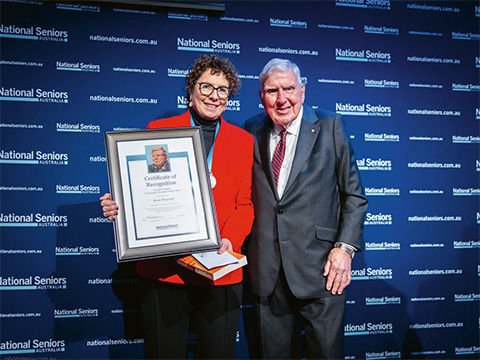
Rosie Fitzgerald, 69, grew up on a farm near the small town of Kilkivan, which is known for being a pioneering gold rush town in Queensland.
When she left Kilkivan at 17 to go to university, she thought she had left small town life behind for good.
“I lived overseas and also taught high school English in Brisbane for 19 years, but I came back to live in Kilkivan with my only child in 1999 and now can’t imagine ever leaving the area,” she explains.
Despite Kilkivan being just two-and-a half hours’ drive from Brisbane, Rosie soon realised just how deprived of support the town’s older residents were.
In 2013, Rosie’s own mother, suffering from Parkinson’s disease, was forced to move to a residential care facility in Gympie as her symptoms progressed.
“Firstly, I saw the devastation my mother—and we family members—endured when she had to relocate from my dad and the family farm. At the time, there were very few options available in our rural area to support Mum at home,” Rosie says.
“She had lived on the farm for 57 years and nearly all of her passions and supports were very local. She passed away in 2016, by which time I was trying to support my former partner who had received a dementia diagnosis, on top of having three chronic conditions requiring twice-daily medication.
“As his condition progressed, and without local family support, he moved back into my home about 2019 and thus for the next six years, he was able to continue living in his local area, still surrounded by familiar people, support workers, and animals.
“I acquired lots of lived experience of caring for someone as an untrained but compassionate person and became increasingly aware of how beneficial that is to living with dementia in a rural setting.
“That really supercharged my belief, that much of the support journey should happen right at the local level, where seniors invariably want desperately to remain.”
While seniors living in large metropolitan centres have a reasonable chance of being able to age in place, their rural counterparts often find this option is disappearing rapidly.
“Rising numbers requiring residential care, especially for those with dementia, means that fewer places within a reasonable distance of their close contacts are almost impossible to find within a timely period,” Rosie explains.
The issue prompted Rosie to found the Kilkivan District Community Care Association Incorporated (KDCCAI), which supports accommodation that allows older residents to remain local rather than relocating to residential aged care outside Kilkivan.
KDCCAI has a four-pillared, integrated approach to help make ageing in place in Kilkivan realistic and sustainable. This approach is inclusive of everyone local—it is a local initiative based on local needs.
The four pillars include community transport; better, more efficient in-home care; social connectivity in a community hub; transitional accommodation to allow down-sizing locally into one-bedroom rental homes; and greater supervision in a share house for those who need it.
“We’ve achieved the first three elements,” Rosie says.
“The share house is now especially needed because of the 168 hours per week that every senior has, less than 15 hours can usually be covered by Support at Home arrangements in our area. That’s a lot of time for anyone to spend unsupported, especially if you no longer drive or have undiagnosed cognition issues and are feeling frightened and confused.
“Seniors here are often very reluctant to admit need because they fear being moved away from where they want to stay, and that ‘hanging on with one’s head down’ can lead to catastrophic falls and other adverse health impacts, which then puts an even greater strain on hospital and ambulance resources.”

Asked what winning the Everald Compton Community Champion Medal means to her, Rosie says:
“I am personally so grateful for this award. It was an incredible surprise to discover I had been nominated and was a national finalist, and to then be announced the winner was astonishing, especially given the calibre of the other finalists.
“But I couldn’t have achieved much without a wonderful, supportive community behind my efforts. I think the award helps add to the credibility of what our ageing-in-place project is aiming to achieve for seniors in our rural area, so that’s a lovely benefit.
“I am hoping that the resultant attention will help attract funding so the transitional accommodation part of the project can be delivered.”
Rosie says it’s sometimes hard to see the impact of individual efforts, but she knows in her bones that addressing as many challenges of ageing in the local area as possible is definitely the way to go.
“Over the past seven years, KDCCAI has tweaked our concept to adapt to changing circumstances but, overall, I passionately believe our concept is evidence-based and has a positive social return on investment,” she says.
“Given the tsunami of dementia and ageing support challenges we are facing, we need politicians to be bold, visionary, and not be blinkered to potential solutions proposed by non-traditional sources. While the big providers are possibly an apt fit for metropolitan needs, rural and regional Australians need another model that can be demonstrated to deliver efficacious use of public funds for ageing-in-place. We believe our model is the answer.”
“The late Professor Richard Scolyer said something near the end of his struggle with brain cancer that really resonated with me: ‘Don’t just lean in. Leap in! That’s how you make a difference.’
“This inspires me every day, as do the selfless, quiet seniors that I see regularly trying to make the best of their situations, often without any family support but still striving to age with dignity.”
While Rosie’s work with KDCCAI keeps her incredibly busy, she’s recently added two very new and exciting individuals to her schedule—twin grandsons.
“These two identical darlings are such a gift—I really love having their parents and them close by so I can be very involved in their childhood. I’m finding that being a grandparent adds such a special dimension to life—I will forever be grateful.”
When she’s not helping out with the grandbabies, Rosie enjoys reading, gardening, and indulging in her other passion—animals.
“My partner Steve and I feed a group of up to 10 wild sulphur-crested cockatoos twice a day, as well as caring for two old horses, whose needs are remarkably similar to we senior humans! Good food, social connectivity, adequate and timely healthcare… They’re probably also wishing for better accommodation!” she laughs.
For more information about KDCCAI, visit kilkivancare.com.au.
This article is featured in National Seniors Australia’s quarterly member magazine, Our Generation.
Become a member today and receive a yearly subscription to Our Generation digital magazine as part of your membership, along with exclusive discounts, competitions, branch access and more!
Your membership directly funds our advocacy and research work that benefits older Australians including fixing pension poverty, tackling health care costs, and improving aged care.