Budget 2026: The good, the bad and the downright ugly
This year’s Federal Budget changes are drawing a mixture of praise and criticism. What it means for seniors depends on who you are and what services you use.

Budgets are more than just dollars and cents. They set out the legislative agenda and the fights that will animate the media and parliament for the coming year.
Key Budget announcements in 2026 set up several fights, with seniors caught in the middle of some of these.
The 2026 Federal Budget has been heavily framed as an opportunity to create greater intergenerational equity.
The Treasurer, Dr Jim Chalmers, has proposed changes to tax concessions and rebates, including changes to the Capital Gains Tax discount and to the private health insurance rebate for seniors through the lens of intergenerational equity.
It didn’t have to be this way. Older people, like younger people, are not a homogenous group, with many older people struggling with rising living costs, a lack of housing, and rising health costs.
Below is a wrap of the key Budget announcements with a call to action on private health insurance rebates.
Private health insurance rebate
A reduction in the higher rebate for seniors has been justified on intergenerational equity grounds, but this is misguided. In truth, the higher rebate saves the government money and supports the sustainability of both the private and public health systems, which helps all generations.
Encouraging older people, especially pensioners and low-income self-funded retirees, to retain private health insurance means they are more likely to contribute to the cost of health out of their own pocket – saving government money!
People will not support user charges for a public hospital system with huge waiting lists for elective surgery, so encouraging older people to retain private insurance makes good economic sense.
This change, from 1 April 2027, will cost a couple aged over 70 currently paying $7,000 a year about $830 a year more in premiums according to our new rebate cut estimator.
Rather than reform the rebate so it is more effective at retaining older people, the government chose to take an axe to a knife fight – effectively chopping off tens of thousands of pensioners from the private health system and burdening others with higher costs to remain in the system.
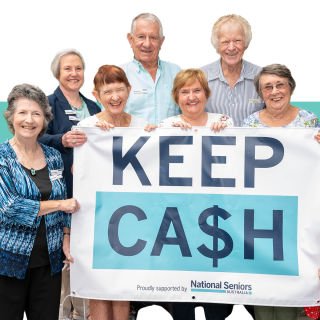
National Seniors Australia (NSA) will fight this change in the media and by lobbying parliamentarians, but we can’t do it alone.
If this change concerns you:
Check out and share our rebate cut estimator with friends and encourage them to join the campaign
The most powerful way for us to be heard is by having real people share the impact of this change through the media (TV, radio and print). It’s not for everyone but if this is something you are willing to do, please email us at policy@nationalseniors.com.au with details of how the rebate change will affect you.

Capital Gains Tax (CGT) and negative gearing
The proposed changes to the CGT discount and negative gearing are complex and will affect people differently, depending on their circumstance.
On the plus side, capital gains made before 1 July 2027 will be grandfathered and continue to attract a 50% discount. Tax on gains made after 1 July 2027 will be subject to the Keating era method using cost base indexation (adjusting the purchase price for inflation), but with a 30% minimum tax on net capital gains.
Assets purchased and fully sold before 1 July 2027 are not affected by the change.
People who buy new investment properties will be able to choose between the 50% discount and the inflation adjusted discount to encourage investment in new housing stock.
The CGT change will impact all assets, such as shares, not just housing assets. The Budget papers say it will apply to assets held by individuals, trusts, and partnerships, but according to CPA Australia, one of the peak accounting bodies, superannuation funds will maintain their current CGT treatment.
The 30% minimum tax is the most controversial change. While some capital gains might be taxed at the 0% or 16% individual tax rates currently, this would apply a minimum 30% tax rate to the net capital gain.
Importantly, Age Pension recipients are explicitly exempt from a 30% minimum tax on capital gains.
The government also intends to apply the 30% minimum tax to some trust distributions from 1 July 2028. This is a very complicated proposal with many details to be confirmed.
Investors purchasing existing housing from 7.30pm on the night of the Budget will no longer be able to claim negative gearing when they purchase an existing dwelling, but newly built dwellings will continue to be eligible. Investors in newly built residential property will also be able to choose either the 50% discount capital gains rules or the new rules.
Other assets, such as commercial property and shares, will continue to be eligible for negative gearing.
In an ominous sign for renters, when a similar policy was introduced in New Zealand in 2021, this resulted in higher rental prices, leading to the policy being abandoned only three years later.
Aged Care: Support at Home
The Government is committing $1 billion over four years to ensure the service type “personal care” is fully funded. This will remove any consumer co-contributions for personal care services, such as showering, through the Support at Home program.
For older Australians on a pension or fixed income, out-of-pocket costs for these daily supports have been a real and growing pressure. NSA has been advocating strongly for this change and welcomes its inclusion in the Budget.
The Budget will fund the release of Support at Home packages to enable more older Australians to remain at home for longer. However, it is unclear how much this will reduce wait times below the current average wait time of 12 months.
Aged Care: Residential aged care
The Budget has allocated funding to incentivise the construction of an estimated 5,000 aged care beds each year. The funds will provide a capital subsidy in the form of a daily payment to providers who build or significantly expand residential accommodation.

Aged Care: Dementia care
The Budget also commits $224.3 million over four years for dementia care, expanding specialist dementia programs and hospital-to-aged-care transition supports. This is a positive step for older Australians living with complex dementia and their families, who often struggle to access appropriate care.
It includes 20 additional Specialist Dementia Care units, more than doubling the current number nationally. The Hospital to Aged Care Dementia Support Program will be expanded from 11 to 20 locations.
Our hope is that this will help to address the needs of stranded patients stuck in the hospital system.
Aged Care: Accommodation supplement
The Budget includes a provision of $1.1 billion for future spending to increase the accommodation payment for low-means residents and an additional payment for high supported residents. This will require further legislation to take effect.
NSA will be closely monitoring the implementation.
RSV Vaccine
In good news for seniors, the government has listed the RSV vaccine on the National Immunisation Program making it free for people aged 75 and over and for Aboriginal and Torres Strait Islander people aged 60 and over. With RSV contributing to hospitalisation, this should help give older people greater protection.
Medicare Urgent Care Clinics
The Budget includes $1.8 billion over five years for Medicare Urgent Care Clinics to expand the network to 137 clinics. These free walk-in services provide an alternative to emergency departments for non-life-threatening conditions, helping older Australians avoid waiting in busy emergency departments.
Hospital funding
The Budget confirms the Commonwealth commitment of an additional $25 billion for state-run hospitals. Older Australians are the highest per-capita users of hospital services, so this sustained investment matters. With older people being increasingly stranded in hospital, we hope that some of this funding will go to support the care and support of older people in hospital and we continue to call for greater attention to this issue.
Fuel costs
The temporary reduction in fuel excise – 32 cents per litre less on petrol and diesel – will run until 30 June 2026 with excise rates returning to normal on 1 July 2026. For those who rely on a car in regional and outer suburban areas, this has provided some short-term relief. This relief has not yet been extended.
Pension Supplement
The Budget includes a change to the Pension Supplement when travelling overseas. Currently, the payment reduces to the supplement basic rate after a person is out of Australia for more than six weeks.
The Budget proposal had this doubling to 12 weeks, from 20 September 2026. However, after 12 weeks the supplement will stop instead of reducing. If someone moves overseas permanently, the supplement will cease when they depart. This is estimated to save the Budget $218 million over five years.
Veterans and allied health
NSA is concerned that overall, there is a cut to veterans’ services. Overall, the Budget lists savings of around $600m over the forward estimates. This includes $169.7m over five years to increase allied health provider fees but also the introduction of a $5,000 annual limit for allied health services, saving the government $779.5m over five years.





Thousands of Australia-wide discounts
Exclusive offers and savings across dining, shopping, gift cards, and more – all in the EAT | PLAY | SAVE app.

Members save 10% on Travel Insurance*
National Seniors members receive a 10% discount on travel insurance policies*.

Financial Information Consultant
Speak to a real person and receive up-to-date information on retirement planning, superannuation, and more!

Branches
Expand your social circle, enjoy social events, day trips, guest speakers, and meet like-minded members.

Exclusive Travel Discounts
Save on tours, cruises, and holidays with exclusive discounts on National Seniors Travel.

Our Generation Digital Magazine
Receive a yearly subscription to Our Generation Digital Magazine.

The Good Guys Commercial
Members enjoy exclusive access to The Good Guys Corporate Benefits. Save on small and large appliances as well as technology.
Advocacy & Research
Your membership directly funds our advocacy and research work fighting issues that affect you.

Competitions
Access exclusive member-only weekly competitions including books, DVDs, CDs, movie tickets and more.

Discounts
In addition to the discounts app, members can save thousands on eGift Cards and other discounted products.