Health costs hit some harder than others
Costs block many older people from healthcare, but some are more likely to go without.

Several years ago, in the midst of the cost-of-living crisis, National Seniors Australia (NSA) surveyed around 6,000 older Australians about the things they went without because of cost.
One question asked whether, in recent years, the cost of healthcare had made people hesitate about accessing the care they needed, or had prevented access altogether.
Readers may recall some of the shocking findings, including 20% of older people going without dental checkups, 24% going without dental treatment, and 26% of those who needed mental health care going without it, all because of cost.
Even for healthcare items most of us would expect to be relatively accessible such as prescription medication and GP appointments, cost still prevented 5%-7% of older people from accessing them.
The NSA research team has burrowed deeper into these numbers to explore how cost affects different subgroups of older Australians.
The numbers show that people dependent on Centrelink payments or other government pensions, and those with lower levels of savings and investments, are far more likely to go without healthcare than other groups.
The numbers show why NSA continues to campaign for additional concessions and relief for older Australians in the lowest wealth brackets, including a Seniors Dental Benefits Scheme and Pensioner Extras Concession Card.
You can click on the links above to check out the details of these policy recommendations.
Less in the bank often means less healthcare
One of the sociodemographic traits we always ask about in our National Seniors Social Survey is the level of savings and investments our survey respondents have, aside from their primary home and belongings.
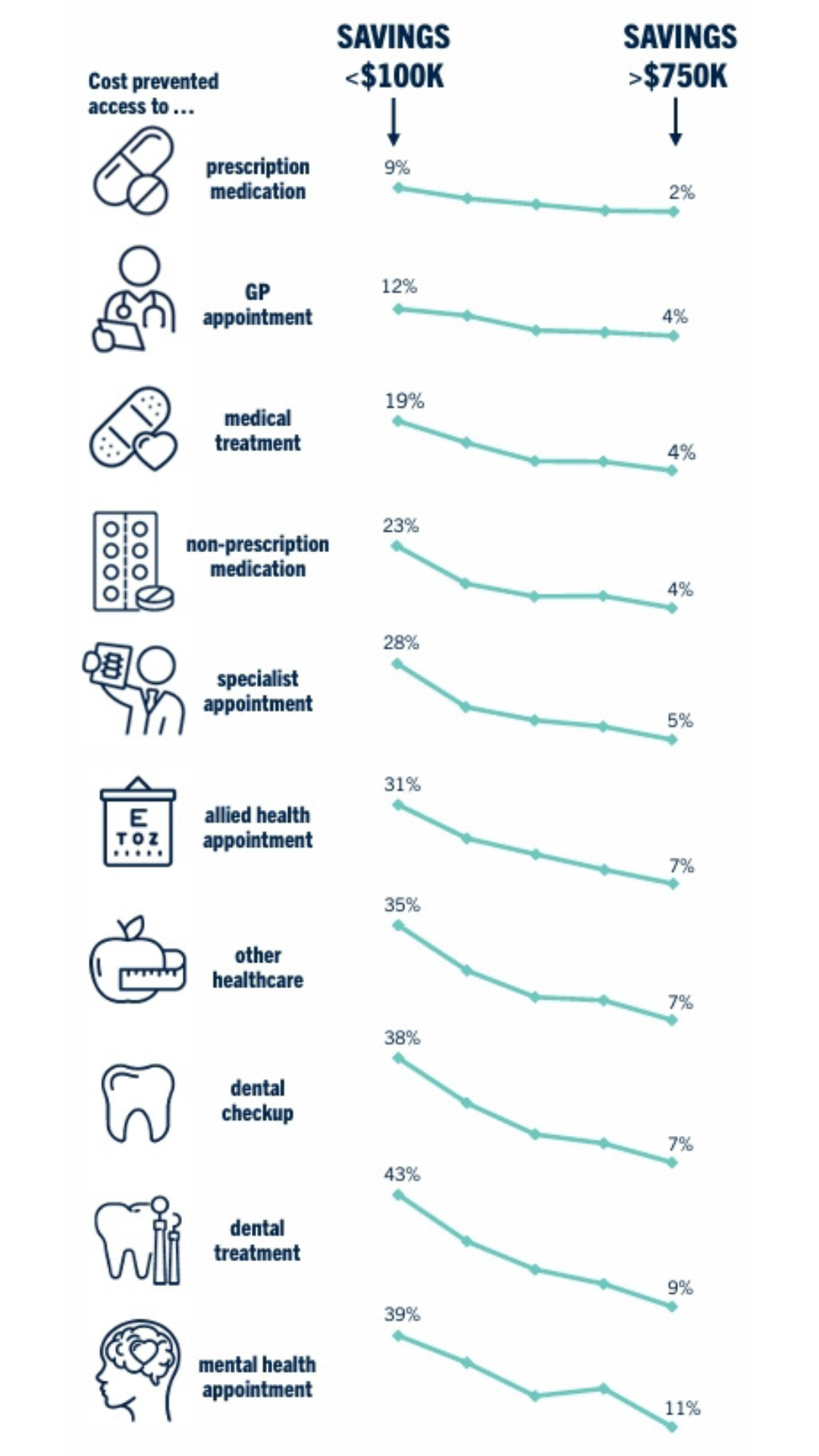
The first infographic (see graphic) illustrates why this is such a useful question to ask.
We grouped respondents into five groups based on it: people with less than $100,000 in savings and investments; people with $100,000 to $200,000; $200,000 to $500,000; $500,000 to $750,000; and over $750,000.
We then calculated the percentage of each who had gone without the healthcare they needed because of cost.
As you can see from the mini graphs, the percentage who went without was highest for the <$100,000 group for all 10 kinds of healthcare.
The percentage was lowest for the >$750,000 group for all 10.
The biggest difference between these groups is for dental treatment. While 9% of people in the top savings bracket didn’t access this because of cost, a whopping 43% of people in the bottom bracket couldn’t get the dental treatment they needed because they couldn’t afford it.
Dental checkups were prohibitively expensive for 38% of the lowest group, and allied health appointments were missed by 31% of them, or almost a third.
Following the same pattern, the percentage decreased as savings level increased among the in-between groups, with just a couple of minor exceptions.
Having said that, the numbers still show that older people at all savings and investment levels sometimes go without the healthcare they need, which is a shocking fact in itself.
But the numbers clearly emphasise the importance of ensuring that our system is calibrated to ensure that older Australians doing it tough are supported.

Pensioners go without care more
The trend is even more stark when we look at wealth based on income rather than savings and investments.
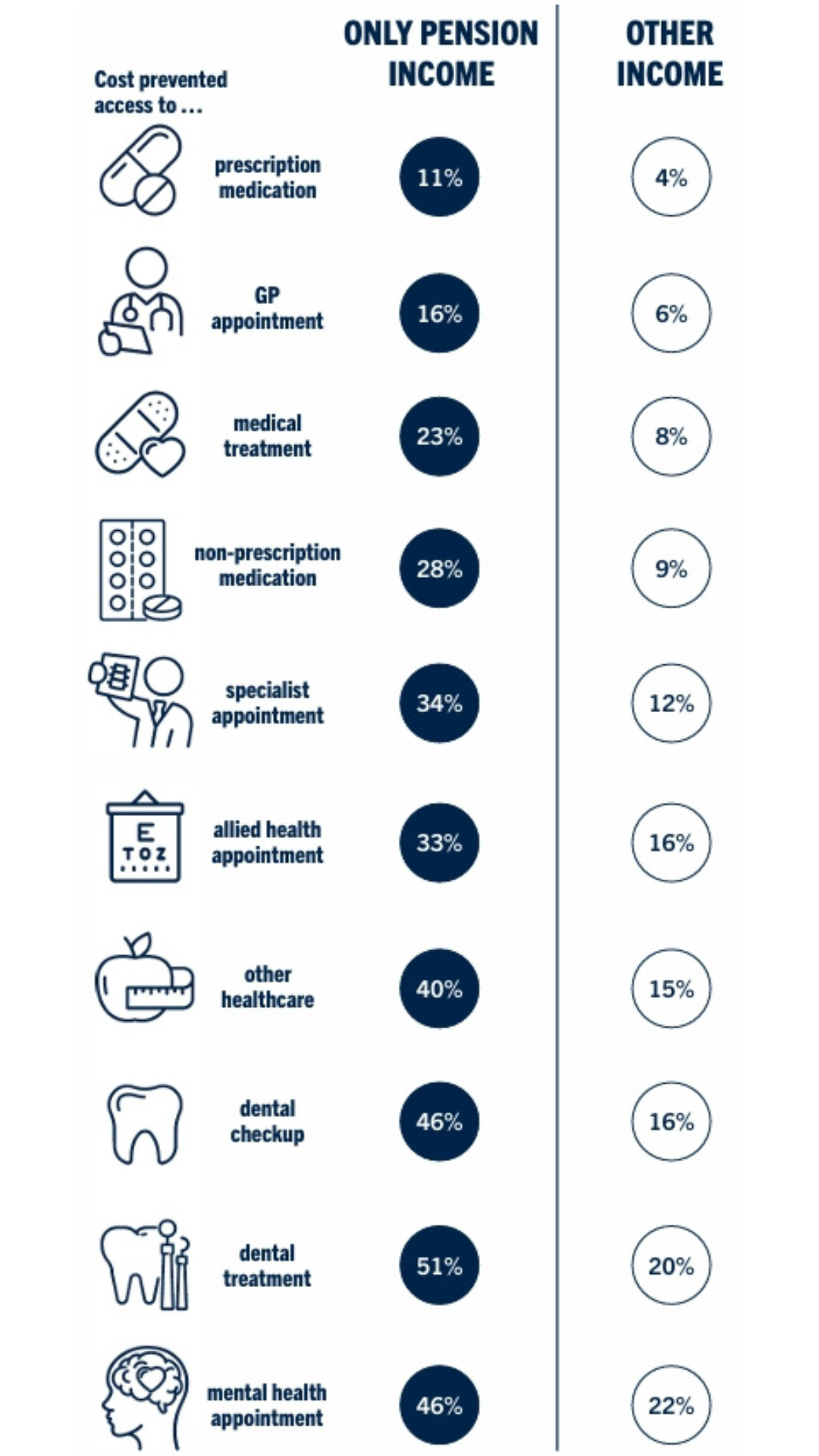
In the second infographic (see graphic) you can see we divided the sample into two groups: those whose sole income was the Age Pension or another government pension, payment or allowance, versus people who drew any income from other sources such as superannuation or wages.
More than half (51%) of those solely dependent on government payments missed out on dental treatment because of cost.
Almost half (46%) of them missed on out on dental checkups and mental health appointments.
Again, some people receiving other sources of income also missed out for every kind of healthcare we asked about, which is never acceptable in a country like Australia. But the proportions of them were lower.
More women and people in regional, rural and remote areas blocked by cost
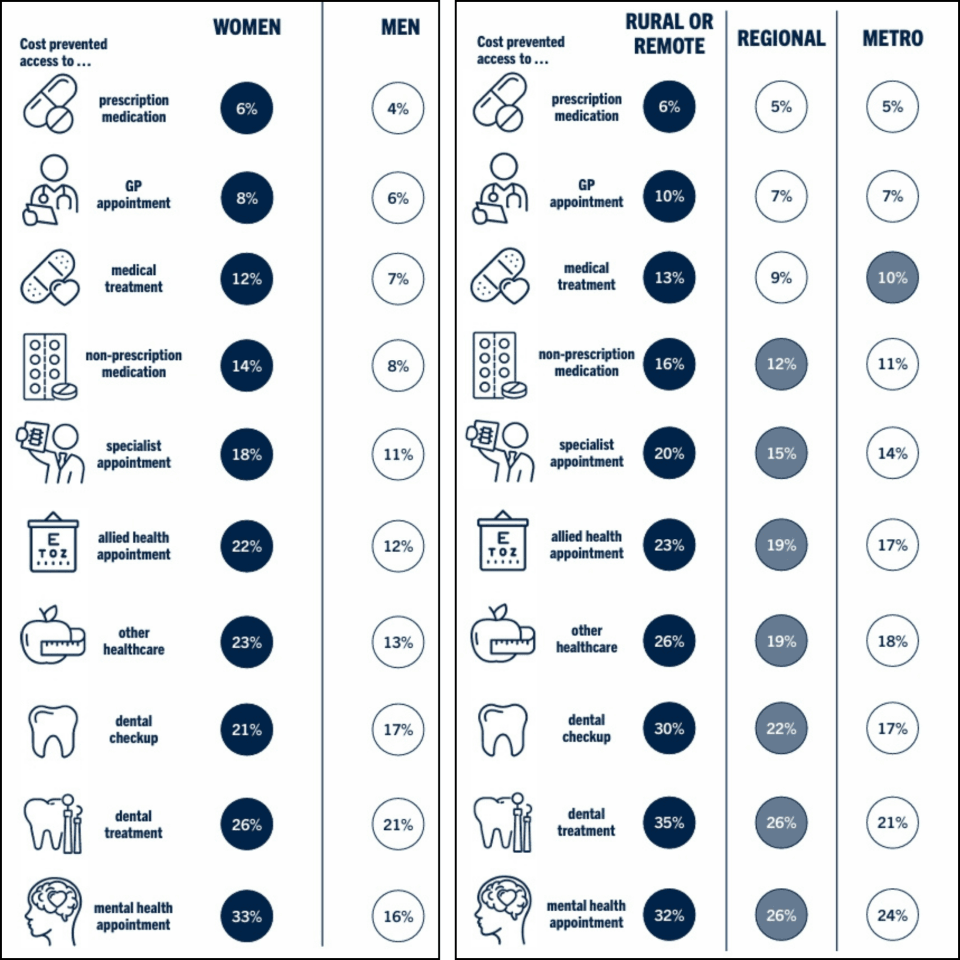
The final two infographics respectively compare the experiences of women to men (below), and the experiences of city dwellers to those in regional centres or in rural and remote areas (below).
On all measures, women went without the healthcare they needed more often than men did.
People from rural and remote locations also fared worse on all measures than those from metro locations. In all but three cases, people from regional locations fell in between the two.
Both of these infographics show us there are still health disparities in Australia associated with demographic traits and social differences.
PHI rebate cut: We need your help
Based on this research, we expect the proposal to remove the higher PHI rebate available to seniors over 65 will disproportionately impact seniors on lower income and with lower wealth.
This will impact all seniors negatively as more people switch to public and less people have private insurance.
If you are a pensioner or part-pensioner and will be impacted, please share your story with us to help the campaign.
What are we fighting for
NSA’s Health Cost campaign strives to get changes that ensure all older Australians can access affordable healthcare.
This includes recommendations for targeting of supports those with limited means:
We have also made policy recommendations affecting all older Australians (that have flow on impacts on low-income groups):
We encourage you to join our Health Costs campaign to show your support for a better health system
Access all the infographics and the original healthcare costs report here.







Thousands of Australia-wide discounts
Exclusive offers and savings across dining, shopping, gift cards, and more – all in the EAT | PLAY | SAVE app.

Members save 10% on Travel Insurance*
National Seniors members receive a 10% discount on travel insurance policies*.

Financial Information Consultant
Speak to a real person and receive up-to-date information on retirement planning, superannuation, and more!

Branches
Expand your social circle, enjoy social events, day trips, guest speakers, and meet like-minded members.

Exclusive Travel Discounts
Save on tours, cruises, and holidays with exclusive discounts on National Seniors Travel.

Our Generation Digital Magazine
Receive a yearly subscription to Our Generation Digital Magazine.

The Good Guys Commercial
Members enjoy exclusive access to The Good Guys Corporate Benefits. Save on small and large appliances as well as technology.
Advocacy & Research
Your membership directly funds our advocacy and research work fighting issues that affect you.

Competitions
Access exclusive member-only weekly competitions including books, DVDs, CDs, movie tickets and more.

Discounts
In addition to the discounts app, members can save thousands on eGift Cards and other discounted products.