Older carers need care – and legislative protection
New NSA research spotlights older carers’ experiences and recommends legislating carers’ rights.

There are 3 million people in Australia who provide unpaid care for partners, children, parents, other family members and friends.
The replacement value of this care in dollar terms has been estimated at $78 billion per year – almost as much as the federal aged care and NDIS budgets combined.
Yet caring is often an invisible contribution that is underestimated and unappreciated by society at large.
New NSA research highlights the critical care older carers provide and the impacts it has on them.
The report Older Australians’ Experiences as Carers is based on results of the 2026 National Seniors Social Survey (NSSS-26), which included a module about informal caring.
Around a quarter of the 4,102 participants said they are a carer or were until recently, with three-fifths of current carers reporting negative impacts from the carer role.
A whopping 89% had not accessed respite care, and half of those who had accessed it reported difficulties doing so. Some didn’t know what respite was.
Very few survey participants – only 29 individuals – mentioned the government’s Carer Gateway when asked about carer support information they had encountered.
These numbers ring alarm bells, showing many older carers are suffering without the support they need, despite the critical unpaid care labour they are providing.
The aged care and NDIS systems don’t provide everything their clients need, and informal carers are the people who pick up the slack.
NSA makes two recommendations in the report:
- That the Federal Government implement the recommendations of the 2023 Parliamentary Inquiry into the recognition of unpaid carers, and legislate carers’ rights, following international examples such as the UK.
- That the Federal Government intensify communications campaigns to promote existing carer supports including Carer Gateway, using language that recognises the enormity of what carers do and the real barriers they face to accessing help.
The care older Australians provide
The definition of a carer in the NSSS-26 module was:
“someone who provides personal care, support and assistance to another person who needs care because they have a disability, a medical condition, a mental illness, or are frail and aged.”
This definition is used by the Department of Health, Disability and Ageing and excludes people who are employed to provide care or who provide care through a study program or voluntary work. It also doesn’t include general parenting and grandparenting.
Caring tasks we asked about in the survey were:
- Help with everyday tasks (e.g. housework, garden work, meal preparation, transport)
- Help with life management (e.g. banking, paperwork, making appointments)
- Help with minor health needs, medications, personal care or mobility.
Consistent with previous research, the carers we surveyed included significantly higher numbers of women.
The carers also averaged more chronic health conditions and felt tighter financially compared to non-carers.
Most of the current carers surveyed cared for people aged 70 and over, with spouses and parents making up the largest proportions of care recipients.
A quarter provided care to more than one person, and three-fifths of carers provided care to someone nearly all the time or daily.
Just under half regularly completed everyday tasks and life management tasks on behalf of their care recipient, and just under a third completed minor health or personal care tasks for the person.
This is over and above the numbers of carers who did these tasks together with the care recipient or assisted with them occasionally. In other words, most of those surveyed regularly provided an intense level of care.
A third of care recipients did not access care from anyone else, paid or unpaid – the survey respondent was the only carer they had. This is a big responsibility for the carers.

Negative impacts of caring
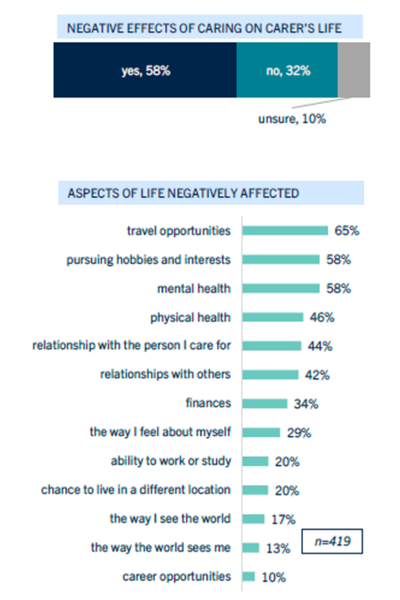
The survey asked current carers if they had experienced negative impacts on their life because of the carer role, and 58% said they had.
This group were then asked about 13 arenas of life that might be affected, and each arena was selected by 10%-65% of those who answered the question.
At the top of the list were travel opportunities and hobbies or interests – often the first things to go for a carer because they are not essential to survive and would often involve leaving the care recipient alone or in the care of others.
But three-fifths also said their mental health was impacted and almost half said their physical health was affected.
Sadly, 44% indicated their relationship with the person they care for had been impacted negatively.
Free-text comments about negative impacts most often emphasised the immense stress and difficulty of caring, the physical and mental toll it can take, the shrinking of the carer’s world and loss of their identity, the feeling of being trapped, and the heavy burden of duty, demands, and responsibility.
Some carers described their unrelentingly negative experience of caring succinctly, in comments like:
“It is the absolute worse experience of my life with no end in sight.”
“It is difficult and life draining being my mother’s carer... I am in my late sixties and feel as if my life is being sacrificed for hers.”
“I can’t have a life because of caring.”
“My job of caring for my husband for 12 years nearly broke me.”
“It left me a physical and mental wreck.”
Some comments in response to a question asking about the positives and rewards of caring expressed similar sentiments, including:
“Nothing is positive about it… It is 24 hours a day of drudgery.”
“There are no positives… It is a full time, thankless role… Long hours, no break, no respite.”
The lack of time to do anything else, the inability to ever be spontaneous, and the care recipient’s refusal to let their carer have respite time off were among the negative effects described in comments that had not been included in the set-response question.
Some carers also expressed scepticism about the notion that carers can help others live independently and remain in their own homes, given the time and sacrifice carers must put in to make this possible.
Several older carers mentioned it was difficult to provide care when they themselves had disabilities, chronic pain, or other limitations due to the effects of ageing.
Others felt grief about losing their retirement period to the carer role when they had hoped it would be finally time for them to relax and enjoy themselves.
These negatives are clearly a serious problem for the individuals affected. But they are also a problem for the nation.
Heavy caregiving burden for carers contributes to the projected ‘carer gap’ between the increasing need for care in the population and the availability of informal carers who support the viability of the care economy.
Those who have intense care responsibilities without adequate support or respite frequently do not have time or resources to invest in looking after their own wellbeing.
Consequently, the physical and mental demands of providing care contribute to carers’ poor health and increased risk of developing multiple chronic diseases, including dementia. Essentially, carers become unable to care for others and are more likely to need care themselves.
The need to legislate carers’ rights
It is clear from all of this that the plight of carers demands greater recognition, and many carers desperately need more support. Carers deserve better.
The Australian Carer Recognition Act legislated in 2010 has 10 principles that address the treatment of carers and how services should be delivered to them and the people they are caring for.
However, the 2023 Parliamentary Inquiry into the recognition of unpaid carers found the Act was essentially aspirational and did not empower carers with any legally enforceable rights, supports or protections.
The inquiry made 22 recommendations to ensure better implementation of the Act’s principles so carers readily receive the recognition, support and services they need.
Unfortunately, recommendations relating to the establishment of carers’ rights (Recommendation 4) and practical recognition of the financial impact of caring (Recommendation 21) were not supported in the government’s response.
Legislated protections such as these would assist carers to access the supports they need and may also help care recipients understand what their care providers are going through and that their need for support such as respite is a standard part of the carer role.
Introducing these protections would not be a radical move for the Australian government. Rather, it would bring this nation into line with what is happening overseas.
For example, in the UK, carers have rights to support and protection from their local authority and the right to a ‘carer’s assessment’ through a GP referral to evaluate their ability to provide care at all.
The NSA report therefore recommends all the recommendations of the Inquiry be implemented.
Time for a national conversation
Perhaps the number of carers in the survey shouldn’t surprise us, as ABS data shows that among women, the most care hours are provided by carers aged 45-74, and among men by carers aged 65+.
Some carers surveyed wrote about the sense of obligation many older Australians feel to care for their spouse or other relatives even when they can’t or don’t want to. This is often unspoken in our society yet widely felt and assumed, and raises questions about fairness, equity, and social structures that must be brought to light and openly discussed.
It’s time for a serious national conversation about who carers are, what they do, how they are impacted, and what they need.
And we must all campaign together for more care and protection for these unsung providers of an essential lifeline to Australians in need.
Read the full report here.
Many Carers’ Day events are scheduled around Australia, and there is an interactive map on the official website.
Among them, the NSA Childers Branch is having a creative pamper morning for carers on 17 October. Details are here.






Thousands of Australia-wide discounts
Exclusive offers and savings across dining, shopping, gift cards, and more – all in the EAT | PLAY | SAVE app.

Members save 10% on Travel Insurance*
National Seniors members receive a 10% discount on travel insurance policies*.

Financial Information Consultant
Speak to a real person and receive up-to-date information on retirement planning, superannuation, and more!

Branches
Expand your social circle, enjoy social events, day trips, guest speakers, and meet like-minded members.

Exclusive Travel Discounts
Save on tours, cruises, and holidays with exclusive discounts on National Seniors Travel.

Our Generation Digital Magazine
Receive a yearly subscription to Our Generation Digital Magazine.

The Good Guys Commercial
Members enjoy exclusive access to The Good Guys Corporate Benefits. Save on small and large appliances as well as technology.

Advocacy & Research
Your membership directly funds our advocacy and research work fighting issues that affect you.

Competitions
Access exclusive member-only weekly competitions including books, DVDs, CDs, movie tickets and more.

Discounts
In addition to the discounts app, members can save thousands on eGift Cards and other discounted products.
*The discount applies to the total National Seniors travel insurance premium and is for National Seniors Australia members only. Discounts do not apply to the rate of GST and stamp duty or any changes you make to the policy. AGA has the discretion to withdraw or amend this discount offer at any time. This discount cannot be used in conjunction with any other promotional offer or discount.
National Seniors Australia Ltd ABN 89 050 523 003, AR 282736, is an authorised representative of AWP Australia Pty Ltd, ABN 52 097 227 177, AFSL 245631, trading as Allianz Global Assistance (AGA), and acts as AGA's agent and not as your agent. nib Travel Services (Australia) Pty Ltd (nib), ABN 81 115 932 173, AFSL 308461 acts as third party administrator on behalf of AGA, managing claims, complaints, enquiries and sales. This is general advice only. Before you buy, you should consider whether the product is appropriate for you, the Product Disclosure Statement (PDS), Financial Services Guide (FSG) and Target Market Determination (TMD) is available from us. This insurance is underwritten by Pacific International Insurance Pty Ltd, ABN 83 169 311 193, AFSL 523921.