What keeps you up at night?
New NSA research reveals the key cost-of-living concerns of older Australians.
Private Health Rebate Cut
NSA is opposing plans to cut the higher PHI rebate for seniors.
With PHI premiums and out-of-pocket costs soaring, a cut to the rebate could be the “straw that breaks the camel’s back”, pushing some to downgrade or drop their cover.
With the government introducing the legislation to Parliament this week, now is the time to oppose this cut.
To help us fight this fight, please sign up to the campaign or share our estimator with friends and family.
New cost-of-living research by National Seniors Australia (NSA) has found that overall older people are most concerned about the affordability of general insurance, power, healthcare, and private health insurance.
The research based on a survey of over 4,000 seniors conducted as part of our annual social survey in February 2026 asked participants to indicate if they were concerned about the affordability of 12 items:
Power
Insurance – car, home, other
Healthcare
Groceries
Transport
Phone and internet
Aged care services
Private health insurance
Interest and hobbies
Holidays and travel
Subscriptions and memberships
Housing
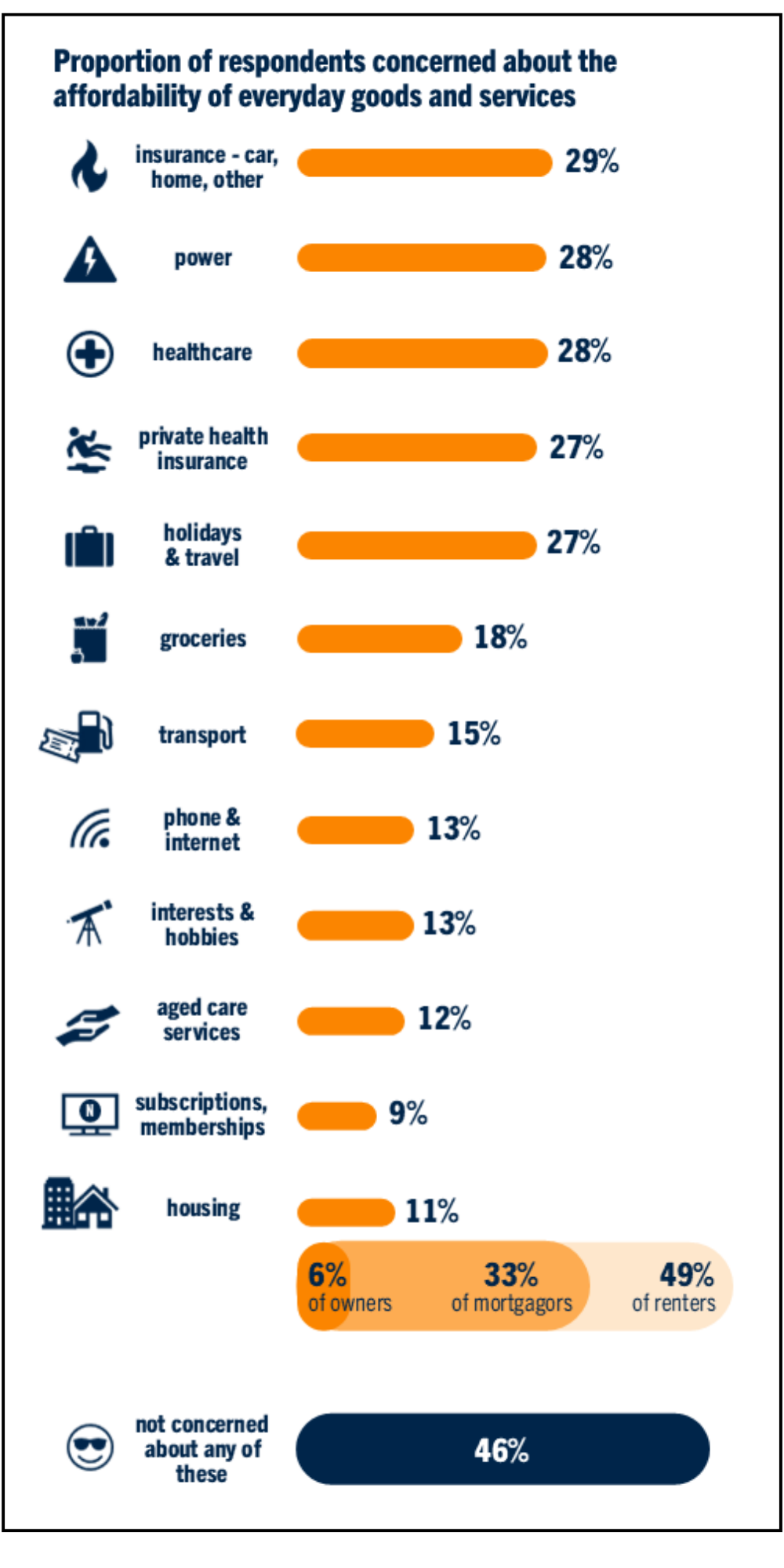
Results showed that while almost half of older people (46%) were not concerned about the affordability of goods and services, concern levels differed greatly depending on the financial circumstances of survey respondents and the specific goods or services in question.
Twice as many survey respondents were concerned about insurance, power, healthcare, and private health insurance compared to other items listed in the survey, including phone/internet and aged care.
While only 15% of seniors were concerned about the affordability of transport, this was before the war on Iran caused fuel prices to spike, so we expect this result to have changed significantly since this time.
Critically, the survey results differed among demographic groups.
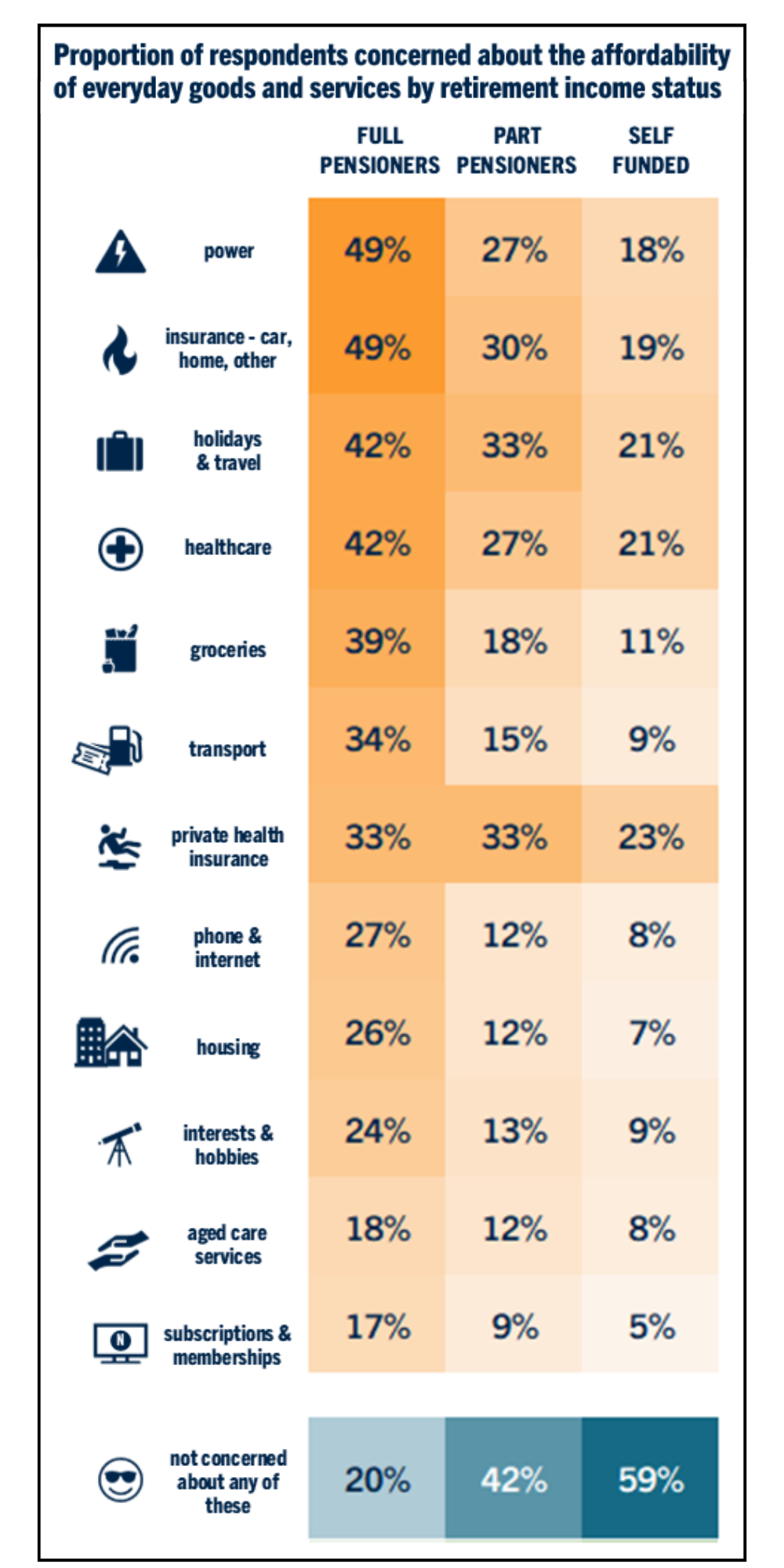
Compared to self-funded retirees, the survey found that a greater proportion of full pensioners were concerned about the affordability of goods and services.
The difference in the proportion of people concerned about affordability was greatest for transport (34% vs 9%, x3.8), housing (26% vs 7%, x3.7), groceries (39% vs 11%, x3.5), subscriptions (17% vs 5%, x3.4), and phone / internet (27% vs 8%, x3.4), when comparing full pensioners with self-funded retirees.
Differences in the proportion of people concerned about affordability was less for power (49% vs 18%, x2.7), interests / hobbies (24% vs 9%, x2.6), general insurance (49% vs 21%, x2.3) and aged care (18% vs 8%, x2.3), when comparing full pensioners with self-funded retirees
The difference in the proportion of people concerned about affordability was lowest for healthcare (42% vs 21%, x2), and holidays / travel (42% vs 21%, x2) when comparing full pensioners with self-funded retirees.
Overall, 59% of self-funded retirees told us they were not concerned about the affordability of any of the listed items compared to only 20% of full pensioners.
Understandably, full pensioners on limited incomes and with limited savings will be more sensitive to the affordability of goods and services, and our survey helps to quantify the level of this sensitivity.
The top concerns for part pensioners were private health insurance (33%), holidays and travel (33%), and general insurance (30%). These items were only nominated by approximately 20% of self-funded retirees.
Interestingly, full pensioners, part pensioners and self-funded retirees were similar in their concern about the affordability of private health insurance, a result that should worry the Federal Government and its plan to cut the private health insurance rebate for seniors.

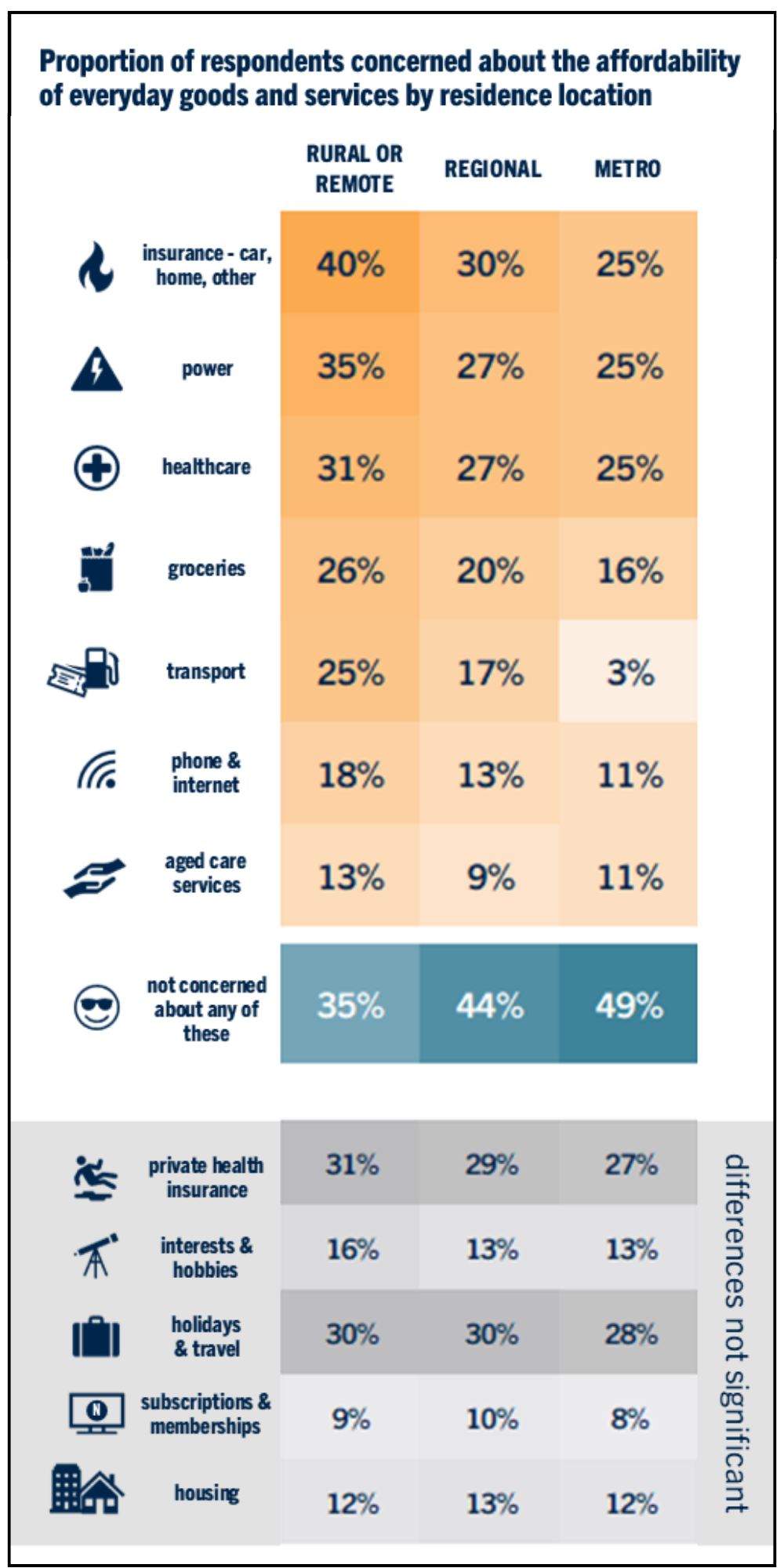
The research also found that affordability concerns were generally higher among people living in regional, rural, and remote areas compared to those living in metropolitan areas.
Of significant concern is housing.
While only 11% seniors overall in our survey listed housing as an affordability concern, which likely reflects strong home-ownership rates among older people, a dramatically higher proportion of owners with a mortgage and renters were concerned, 33% for those with a mortgage and 49% of renters.
The results reinforce several key policy recommendations made by National Seniors Australia:
Let Pensioners Work: exempt work-related income from the Age Pension
Pensioner Extras Concession Card: create a dedicated concessions card to support low-income pensioners
Rent Assistance: increase the maximum rate of Commonwealth Rent Assistance (CRA) payment
Review private health: comprehensively review the private health system to reduce cost pressures
Seniors dental scheme: create a targeted Seniors Dental Benefit Scheme.
With cost-of-living concerns continuing to be top of mind, NSA intends to repeat this survey early next year to reassess seniors’ concern about the affordability of everyday goods and services.




Thousands of Australia-wide discounts
Exclusive offers and savings across dining, shopping, gift cards, and more – all in the EAT | PLAY | SAVE app.

Members save 10% on Travel Insurance*
National Seniors members receive a 10% discount on travel insurance policies*.

Financial Information Consultant
Speak to a real person and receive up-to-date information on retirement planning, superannuation, and more!

Branches
Expand your social circle, enjoy social events, day trips, guest speakers, and meet like-minded members.

Exclusive Travel Discounts
Save on tours, cruises, and holidays with exclusive discounts on National Seniors Travel.

Our Generation Digital Magazine
Receive a yearly subscription to Our Generation Digital Magazine.

The Good Guys Commercial
Members enjoy exclusive access to The Good Guys Corporate Benefits. Save on small and large appliances as well as technology.
Advocacy & Research
Your membership directly funds our advocacy and research work fighting issues that affect you.

Competitions
Access exclusive member-only weekly competitions including books, DVDs, CDs, movie tickets and more.

Discounts
In addition to the discounts app, members can save thousands on eGift Cards and other discounted products.
*The discount applies to the total National Seniors travel insurance premium and is for National Seniors Australia members only. Discounts do not apply to the rate of GST and stamp duty or any changes you make to the policy. AGA has the discretion to withdraw or amend this discount offer at any time. This discount cannot be used in conjunction with any other promotional offer or discount.
National Seniors Australia Ltd ABN 89 050 523 003, AR 282736, is an authorised representative of AWP Australia Pty Ltd, ABN 52 097 227 177, AFSL 245631, trading as Allianz Global Assistance (AGA), and acts as AGA's agent and not as your agent. nib Travel Services (Australia) Pty Ltd (nib), ABN 81 115 932 173, AFSL 308461 acts as third party administrator on behalf of AGA, managing claims, complaints, enquiries and sales. This is general advice only. Before you buy, you should consider whether the product is appropriate for you, the Product Disclosure Statement (PDS), Financial Services Guide (FSG) and Target Market Determination (TMD) is available from us. This insurance is underwritten by Pacific International Insurance Pty Ltd, ABN 83 169 311 193, AFSL 523921.