Sporty by nature
Mobility challenges in older age can limit activity. Now, a wave of new, accessible sports is taking Australia by storm and the only requirement to play is a love for the game.
By Meghan Fallis

For a long time, fast-paced and physically challenging sports, like football and tennis, have largely been reserved for the fitter, faster, and more agile individuals among us. But this is all changing with the establishment of clubs and teams across the country encouraging people to play sport in whatever capacity their bodies allow.
By modifying equipment, rules, and playing environments, these sports are enabling people of all ages and abilities to reap the rewards of social exercise without the risk of injury or intimidation.
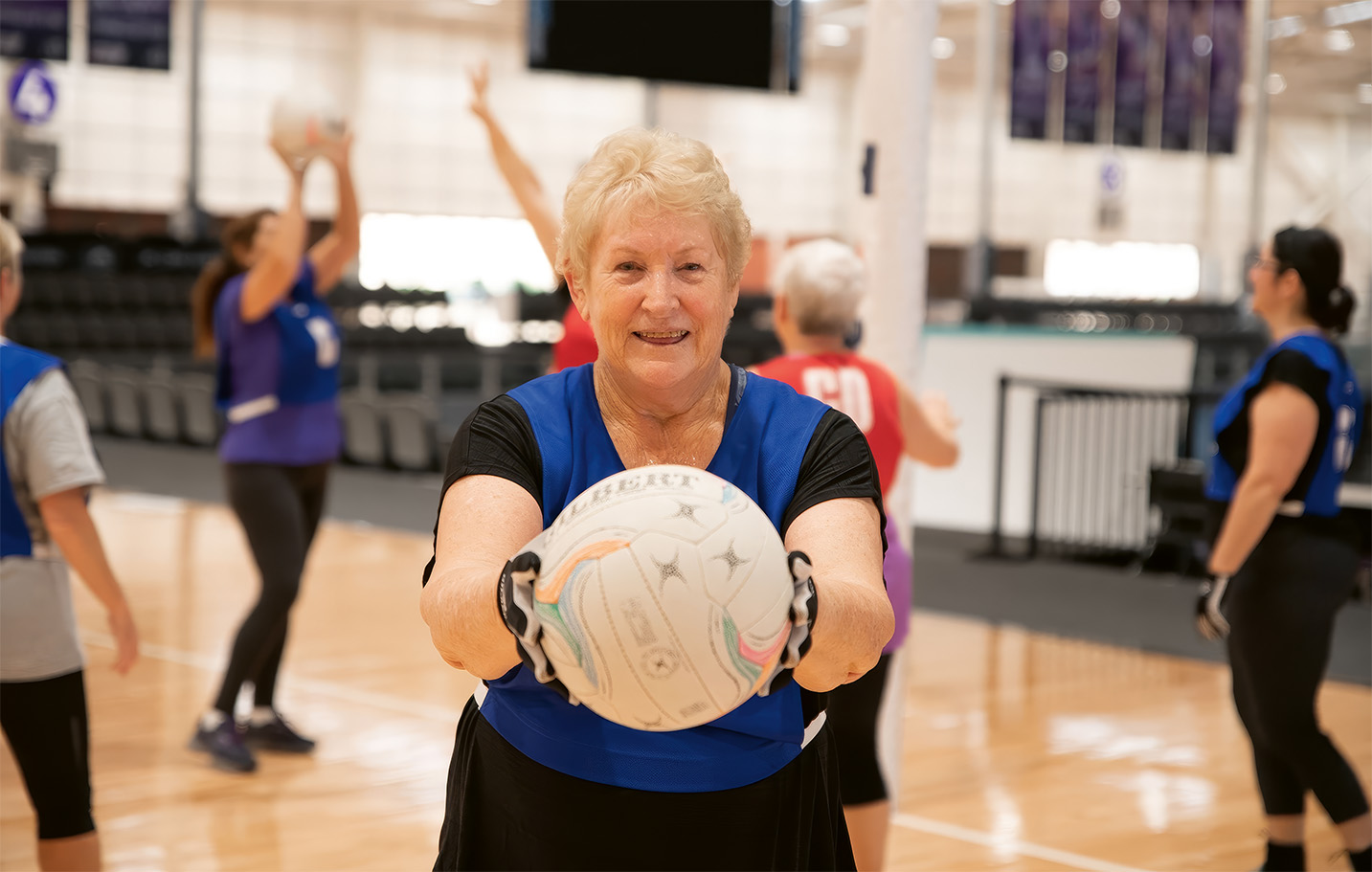
Walking netball is one such sport that’s taking off across Australia. Walking Netball Brisbane coordinator, Sue Mitchell, says eliminating risky movements, like running, means people can continue to enjoy the sport at an intensity that suits them.
“Where do you think people go after they stop playing top netball? If they still want to play netball, where are they going to go? There aren’t always competitions and associations that cater for older people. So, they come to walking netball,” Sue says.
“The rules haven’t changed a lot, and we’ve certainly adapted them for walking netball to make it safer for people.
“We have a lot of people of various abilities as well. Somebody who has never played before might go up against somebody who’s been playing for years.”
A self-described netball tragic, Sue started playing when she was just seven years old, although at the time it was called women’s basketball. Sue continued playing until two years ago when she had knee and hand surgery.
Now 80, Sue says she still gets her exercise and socialising through her roles coordinating and umpiring walking netball.
“I have so many people contact me saying, ‘I’m in my 50s but it’s been years since I’ve played, and I don’t know whether I could play again.’ And I just say, it doesn’t matter. When you come to walking netball, everybody will help you. And if I’m not hearing laughter with people on the court, there’s something wrong,” Sue says.
The Australian Government recommends at least 30 minutes of moderate-intensity daily physical activity for people aged 65 and over. Despite this, less than one in five Australians (18.3%) in this age group met guidelines for physical activity in 2024 (the most recent available data).
Sue says that sports like walking netball are a great way for older Australians to not only stay active but also to reconnect with others.
“A lot of people, as they get older, they don’t always exercise. I tell people, just come and have a look. And I can guarantee that after the first couple of minutes, you will want to be on the court as well,” Sue says.
“When we play, we always have coffee after and just chat about absolutely anything. As you get older, a lot of people live alone and need contact with other people. You need somebody that you can just talk to.
“Some people have even gone to school or university together and then lost touch and have reconnected through walking netball. And that’s the great thing about sport—it draws in people from everywhere.”
Walking, swimming, and golf are popular among Australians 55 and above, but other low-impact sports like pickleball have boomed in recent years too. Easier on the joints and heart rate, chair volleyball is another adapted sport encouraging older Australians to get involved across a broader range of sport and exercise.
The Bethanie Social Centre offers a community space for socialising and collaboration for the clients of Bethanie, an aged care provider based in Perth. Social Centre coordinator, Anja Danner, says including regular chair volleyball matches in the centre’s schedule has brought a new sense of livelihood for Bethanie clients.
“Our clients all live at home and come to the Social Centre for the day. It’s an opportunity for them to engage with others and reconnect ... because unfortunately, a lot of their friends might have passed,” Anja says.
“Our neighbours here are Volleyball Western Australia. I walked over there one day and they said they were offering senior volleyball, and asked if we were keen on having a session. That was really fun. So, we bought a special net, and it went from there.”
Alongside its senior volleyball, Volleyball Western Australia also offers an Adaptive Volley program which features sitting, standing, and chair volleyball, and is suitable for wheelchair users.
With a smaller court size, a lower net, and other modifications facilitating gameplay, many Bethanie clients were able to participate. What started with clinics grew to infrequent tournaments with many spectators. In early 2022, chair volleyball expanded into a beloved, weekly friendly competition for Bethanie clients.
“I wanted to try something different. And I thought, why not? I loved it and I haven't wanted to stop. In fact, I'm thinking of joining the over 55s team to do it once a week as well,” Bethanie client Joyce Ballanytyne says.
“The whole thing is not the winning or the losing, although winning does help. But it’s just a lot of fun—exuberant, tiring, but most of all fun.
“I think with the volleyball, apart from the socialising, you also have to remember the rules, like you’re not allowed to stand up—you lose a point—or if you touch the ball three times, you lose a point. We start to lose a little bit of our memory as we get older, so trying to remember the rules keeps your mind active as well, which is a good thing.”

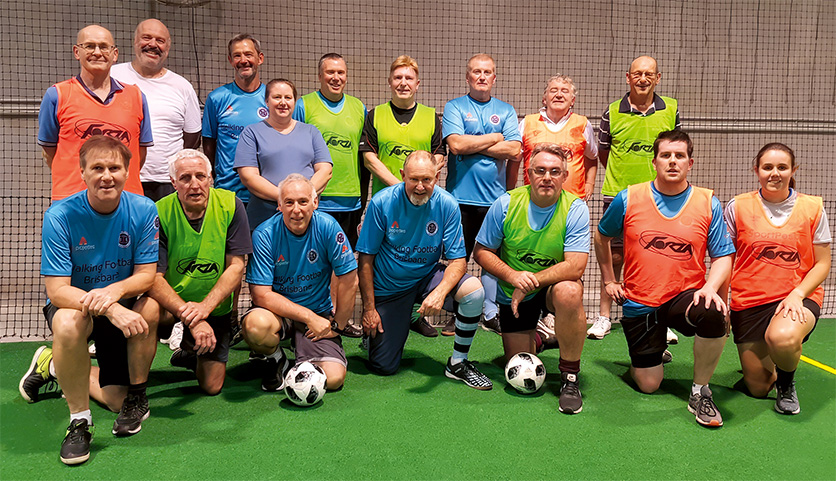
Queensland-based David Stoyakovich stumbled across walking football (soccer) on a television program one Saturday afternoon in 2018. By Sunday, he had travelled to watch a local session in Brisbane’s north, and a few months later, he was playing in a men’s 60s team in one of Australia’s first interstate tournaments, organised by Walking Football Brisbane.
“It’s essentially a futsal-sized field that we play on. So, a little bit less than a quarter of the size of a regular soccer field with smaller goals. Generally, it’s teams of six against six including goalkeepers,” David says.
“We’ve got a range of members with a broad range of skills and abilities. And one of the good things about walking football is it’s a great leveller. So, once you take running and tackling out of the game, players can only rely on their foot skills.
“Unfortunately, the name Walking Football conjures up images of old men with Zimmer frames… But we found that age doesn’t really matter in walking football, so we removed the age restriction at our club. Now we have junior members and adult members from their 20s to their 80s, and we all play together.”
Before joining the club, David hadn’t played football in four decades due to a sporting injury he sustained when he was 19. David has now represented the Australian men’s 60s Walkaroos rep team at the Walking Football World Championship in Chesterfield, England (2024) and the men’s 65s team in Malmö, Sweden (2025).
Currently serving as secretary for Walking Football Brisbane, David said that after his injury, he never thought he would play the sport again.
“When I did my ACL playing for the university team, I decided, ‘Look, I'll hang up my boots and just concentrate on my studies’,” David says.
“Now I’m getting a chance—even though it’s later in life—to relive the glories that I missed in my younger years, in my 20s and 30s.
“I love it. Every day I pinch myself and thank Alan Templeton [Walking Football Brisbane founder] for bringing this wonderful game back into my life.”
The Walking Football World Championships will be held on Aussie turf for the first time in 2026. With four days of competition spanning 28–31 May on his team’s home soil in Brisbane, David hopes the word of walking football continues to spread across Australia.
“There are so many opportunities today for people in their 50s, 60s, and beyond to get involved in sports or to rekindle—or get reacquainted with—sports they thought they would never play again,” David says.
“Whether it’s walking football, walking rugby, walking netball, or walking basketball—we’ve found our new niche in the sports world and we’re not going away.
“There’s no better time to be old.”

This article is featured in National Seniors Australia’s quarterly member magazine, Our Generation.
Become a member today and receive a yearly subscription to Our Generation digital magazine as part of your membership, along with exclusive discounts, competitions, branch access and more!
Your membership directly funds our advocacy and research work that benefits older Australians including fixing pension poverty, tackling health care costs, and improving aged care.