Will pension deeming rates rise?
With indexation of the pension likely to coincide with another deeming rate rise, will you be affected?
What are deeming rates?
Deeming rates are used to assume the returns people receive on their financial assets that the government applies to Age Pension means testing. As market returns fall, deeming rates are supposed to fall and vice versa.
There are two deeming rates applied to a person’s financial assets. A lower rate applies to assets up to a threshold and a higher rate to financial assets over the threshold.
As at 30 January 2026, the lower rate of 0.75% applies to the first $64,200 (single) and $106,200 (couple) of financial assets; a rate of 2.75% applies to financial assets above that level. If your investment earns more than the deemed rate, this doesn’t count as income, but if your returns are less than the deeming rate, you are worse off.
Deeming rates aren’t only relevant for people receiving the age pension and other social security payments. It also impacts eligibility for the Commonwealth Seniors Health Card and can determine what rate of co-contributions people pay for in-home aged care under Support at Home.
In less than a month, the Federal Government will announce if deeming rates are set to rise for the second time in six months.
Any change to deeming rates may have a material impact on the payment rate of pensioners – specifically part-rate and full-rate pensioners, either under the income test or near the threshold at which the part-pension kicks in.
A rise in deeming rates will reduce pension payments, while a fall in deeming rates will increase pension payments for those under the income test.
In September last year, the Federal Government ended the freeze on deeming rates, raising them from the historic low rate of 0.25% / 2.25% they had been at since early 2020 to 0.75% / 2.75%. Prior to that, deeming rates had been declining for a decade, in line with falling interest rates, with the last increase in deeming rates being in 2010.
Luckily, after advocacy by National Seniors Australia (NSA) and other seniors organisations, the government decided to time the deeming rate increase in line with indexation to reduce the impact on pension payments.
The modest increase in deeming rates, combined with higher inflation increasing the maximum payment rate, made it unlikely that anyone would see their pension go backwards. But this may not be the case in the future if inflation is muted.
Since the freeze was lifted, the Federal Government has enlisted the assistance of the Australian Government Actuary (AGA) to provide it with advice on how deeming rates should be set.
Going forward, the AGA will review the deeming rates and give advice to the Minister by 1 February and 1 August each year. This will allow the government to consider the advice – it doesn’t need to be accepted – and make an announcement of any change to deeming rates at least one month before the pension indexation and any potential deeming rate change: 20 February ahead of the 20 March indexation, and 20 August for the September indexation.
This means the government should be receiving the first advice by the time this article goes to print and will likely make an announcement on deeming rates sometime in the next three weeks.
It is unclear the exact method the AGA will use to make its advice, though the government has published some broad considerations:
It states that, in reviewing the deeming rates, the AGA will consider the investment returns reasonably available to age pensioners and other income support recipients and aim to ensure returns equal to the recommended deeming rates can be achieved:
- Without specialised financial knowledge or levels of financial literacy beyond reasonable expectations for affected age pensioners
- Through readily available investment products provided by major banks and financial institutions
- Without investment risks disproportionate to the assets reasonably held by affected age pensioners.
The AGA will analyse the returns for financial assets held by those impacted by deeming rates and have administrative data from the DSS on the asset holdings of those who are above and below the deeming threshold.
The AGA will also consider broader economic factors. This could include RBA Cash Rate decisions, with the next RBA meeting concluding on 3 February.
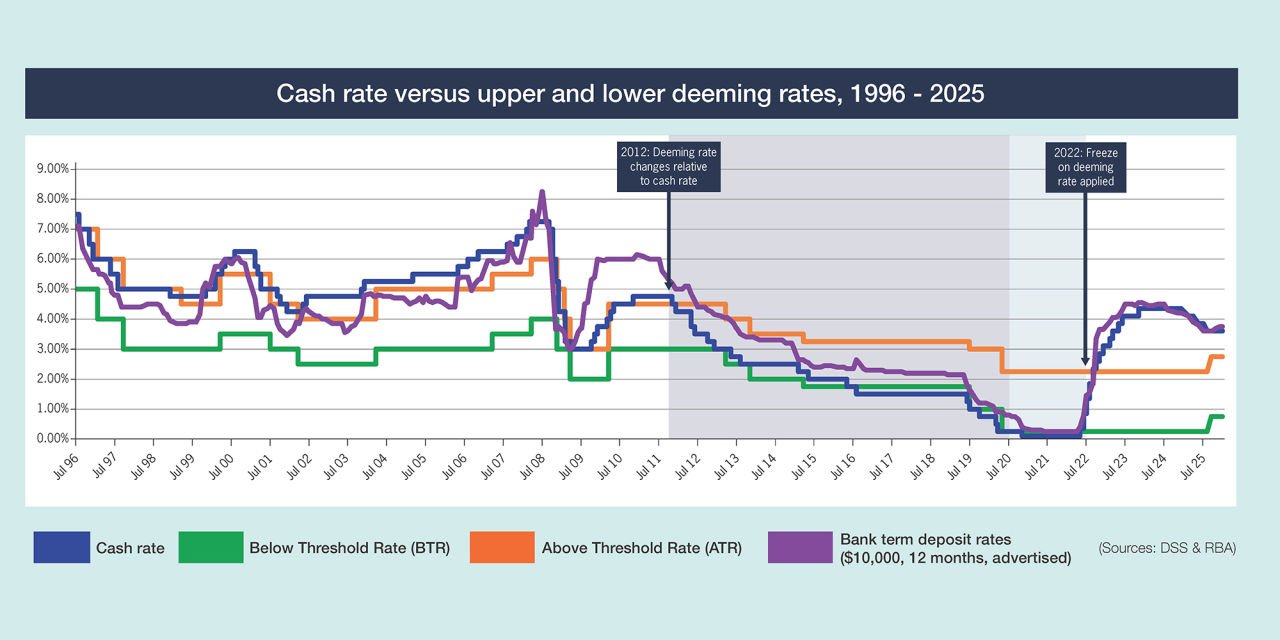
While the deeming rates were not officially linked to the Cash Rate, previously either the lower or the upper deeming rate followed the movement of the Cash Rate.
The AGA will set out what it determines to be appropriate levels for the lower and upper deeming rates, which will be set in increments of 0.25%, with the lower deeming rate having to be above 0% and the upper deeming rate at least 0.25% above the lower deeming rates.

Will deeming rates rise?
It is highly likely that the only direction for deeming rates over the short-to-medium term is up. The freeze on deeming rates coincided with a rapid increase in the RBA cash rate and investment returns. As the graph above shows, deeming rates are now much lower than market returns.
Late last year the Australian Financial Review reported, based on an unnamed government source that “even though the government had devolved the decision-making to the Australian Government Actuary, it was all but certain deeming rates would increase again in March.”
It is unclear how high the AGA may recommend deeming rates go. Historically they have been as high as 5% / 7% in the mid-1990s when interest rate were unusually high. The deeming rates are already higher than they have been since 2013, and 3% / 5% or 4% / 6% would be historically consistent.
But there are good reasons for the government to be cautious.
As National Seniors Australia (NSA) has advocated to Minister for Social Services, Tanya Plibersek, and to the AGA, it is important that government takes a slow and steady approach to changing deeming rates.
The last increase was 0.5% and occurred at the same time as indexation. That meant that most people did not experience a significant fall in their pension payment at a time that cost-of-living pressures remain. If the deeming rates are increased too fast, indexation will not offset a reduction in pension payments and people will see less pension in their bank accounts.
Another concern is how they increase deeming rates. Everyone knows that savings accounts offering easy access to funds offer very limited investment returns. Those who need to have money on hand (especially those having to withdraw money from superannuation due to compulsory draw down rules) will be penalised by any increase in the lower deeming rate.

A general rule of thumb is that you should have two years’ worth of savings accessible for unexpected costs and emergencies, which roughly coincides with the deeming rate threshold (see break out). As such, the lower deeming rate for savings below the threshold should reflect actual bank savings rates – not conditional savings rates or more generous term deposit rates which lock savings away.
Reserve Bank of Australia data (Advertised Deposit Rates – F4) shows that online savings accounts at $10,000 received an interest rate of 1.30% per annum in December 2025. Any increase in the lower deeming rate above this amount would be unfair as it would not reflect the reality facing pensioners who need access to their funds.
Our fear is that the government is looking at interest rates attached to conditional savings accounts or term deposit rates as the benchmark for the lower deeming rate. This would be unfair as it doesn’t reflect reality.
Most modern savings accounts have conditions that have to met (such as no withdrawal of funds or rising balances over a set period) in order for a higher rate to be paid. The Australian Competition and Consumer Commission found in its retail deposits inquiry in 2023 that “71% of bonus interest accounts did not receive the bonus interest rate on average each month over the first 6 months of 2023”.
While the official pension indexation figure won’t be known for a while yet, NSA will be able to estimate the increase when CPI figures are released late in January, so watch this space. Our hope is a slow and steady return to minimise impacts on pensioners.
Please consider joining our Retirement Income campaign to show your support for our advocacy on deeming rates.





Thousands of Australia-wide discounts
Exclusive offers and savings across dining, shopping, gift cards, and more – all in the EAT | PLAY | SAVE app.

Members save 10% on Travel Insurance*
National Seniors members receive a 10% discount on travel insurance policies*.

Financial Information Consultant
Speak to a real person and receive up-to-date information on retirement planning, superannuation, and more!

Branches
Expand your social circle, enjoy social events, day trips, guest speakers, and meet like-minded members.

Exclusive Travel Discounts
Save on tours, cruises, and holidays with exclusive discounts on National Seniors Travel.

Our Generation Digital Magazine
Receive a yearly subscription to Our Generation Digital Magazine.

The Good Guys Commercial
Members enjoy exclusive access to The Good Guys Corporate Benefits. Save on small and large appliances as well as technology.
Advocacy & Research
Your membership directly funds our advocacy and research work fighting issues that affect you.

Competitions
Access exclusive member-only weekly competitions including books, DVDs, CDs, movie tickets and more.

Discounts
In addition to the discounts app, members can save thousands on eGift Cards and other discounted products.
*The discount applies to the total National Seniors travel insurance premium and is for National Seniors Australia members only. Discounts do not apply to the rate of GST and stamp duty or any changes you make to the policy. AGA has the discretion to withdraw or amend this discount offer at any time. This discount cannot be used in conjunction with any other promotional offer or discount.
National Seniors Australia Ltd ABN 89 050 523 003, AR 282736, is an authorised representative of AWP Australia Pty Ltd, ABN 52 097 227 177, AFSL 245631, trading as Allianz Global Assistance (AGA), and acts as AGA's agent and not as your agent. nib Travel Services (Australia) Pty Ltd (nib), ABN 81 115 932 173, AFSL 308461 acts as third party administrator on behalf of AGA, managing claims, complaints, enquiries and sales. This is general advice only. Before you buy, you should consider whether the product is appropriate for you, the Product Disclosure Statement (PDS), Financial Services Guide (FSG) and Target Market Determination (TMD) is available from us. This insurance is underwritten by Pacific International Insurance Pty Ltd, ABN 83 169 311 193, AFSL 523921.