Budget 2026: The good, the bad, and the downright ugly
This year’s Federal Budget goes beyond the balance sheet, making decisions that will shape the lives of older Australians with some welcome gains, serious concerns, and a few deeply troubling choices along the way.

Federal budgets are about much more than numbers on a page. They set the national agenda, shape policy priorities, and ultimately, determine who benefits, and who bears the cost.
This year’s Budget is no exception. Framed around the theme of ‘intergenerational equity’, it delivers a mix of welcome reforms and troubling trade-offs, with older Australians caught squarely in the middle.
For National Seniors Australia (NSA), the 2026 Budget is best understood in three parts—the good, the bad, and the downright ugly.
Let’s start with what the Budget gets right.
After years of advocacy, there is meaningful investment in aged care—an area that has long needed reform. New funding will expand home care services, increase the number of aged care places, and improve support for people living with dementia.
Critically, reforms to the Support at Home program will remove co-payments for essential personal care services such as showering, dressing, and continence care. These are not optional extras; these services are fundamental to dignity and quality of life. Their full subsidisation is a practical and necessary step toward a fairer system.
The Budget also promises to reduce waiting times for Home Care Packages, a persistent issue that has left too many older Australians without the support they need. Faster access to care means fewer avoidable hospitalisations, less strain on carers, and a better chance for people to remain safely in their own homes.
In short, there is genuine progress here and it reflects the voices of older Australians who have been calling for change. But as always, there is likely more that could be done.
In good news for seniors, the government has listed the RSV vaccine on the National Immunisation Program making it free for people aged 75 and over, and for Aboriginal and Torres Strait Islander people aged 60 and over. With RSV contributing to hospitalisation, this should help give older people greater protection.
The temporary reduction in fuel excise—32 cents per litre less on petrol and diesel—will run until 30 June 2026 with excise rates returning to normal on 1 July 2026. For seniors who rely on a car in regional and outer suburban areas, or grey nomads travelling the country, this has provided some much-needed relief.

While there is $169.7 million over five years to increase allied health provider fees, the introduction of a $5,000 annual limit for allied health services has been included, which will save the government $779.5 million over five years. We will be seeking clarification on this.
The Budget also introduces significant structural changes to taxation rules that may have flow-on effects for retirees and those approaching retirement.
Impacts vary based on individual circumstances and investment choices.
A key feature of the changes to treatment of Capital Gains Tax (CGT) is the grandfathering of existing arrangements for gains accrued before 1 July 2027, which will receive the current 50% discount. This provides certainty for existing investors.
From 1 July 2027, a new system will apply to future gains. Instead of the flat 50% discount, gains will be calculated using inflation indexation of the purchase price, paired with a minimum 30% tax on net capital gains. This is a significant shift, as it means all gains are taxed at a minimum rate—even for individuals who currently pay little or no tax.
Importantly, Age Pension recipients are exempt from this minimum tax.
The CGT changes extend beyond housing, applying to assets such as shares and investments held by individuals, trusts, and partnerships.
However, superannuation funds are expected to retain their current CGT treatment.
To encourage housing supply, the government is introducing incentives for newly built residential properties.
Investors in new builds can choose between the existing 50% CGT discount and the new indexed method. By contrast, investors who purchase existing properties after Budget night will no longer be able to claim negative gearing.
Negative gearing will still apply to new housing and other asset classes, such as commercial property and shares.
The most concerning element of this Budget—and the one NSA will continue to fight—is the decision to slash the private health insurance rebate for seniors.
From April 2027, older Australians will lose access to the higher rebate they currently receive, bringing them into line with younger age groups. The government argues this creates fairness between generations. But from our perspective, it is a deeply flawed approach.
The higher rebate was never a bonus—it was a strategic incentive. It encouraged older Australians, who are more likely to need healthcare, to maintain private cover. This, in turn, reduced pressure on the public hospital system and saved taxpayer dollars in the long run.
Removing it risks undermining that balance.
Estimates suggest millions of Australians over 65 will face higher premiums, with many likely to downgrade or abandon their cover altogether. For those already struggling with rising insurance costs, this could be the tipping point.
This is why NSA has described the measure as misguided.
Encouraging older Australians to contribute to their own healthcare through private insurance is not only fair—it is economically sensible.
Cutting the rebate risks creating a false economy, where savings in one part of the system lead to higher costs elsewhere.
NSA will continue to advocate strongly on behalf of older Australians, particularly in opposing the reduction in the private health insurance rebate.
But we cannot do it alone.
If this Budget has shown anything, it is that the voices of older Australians matter and must continue to be heard.
All the more reason to remain a member of NSA.
Thank you for your ongoing support.
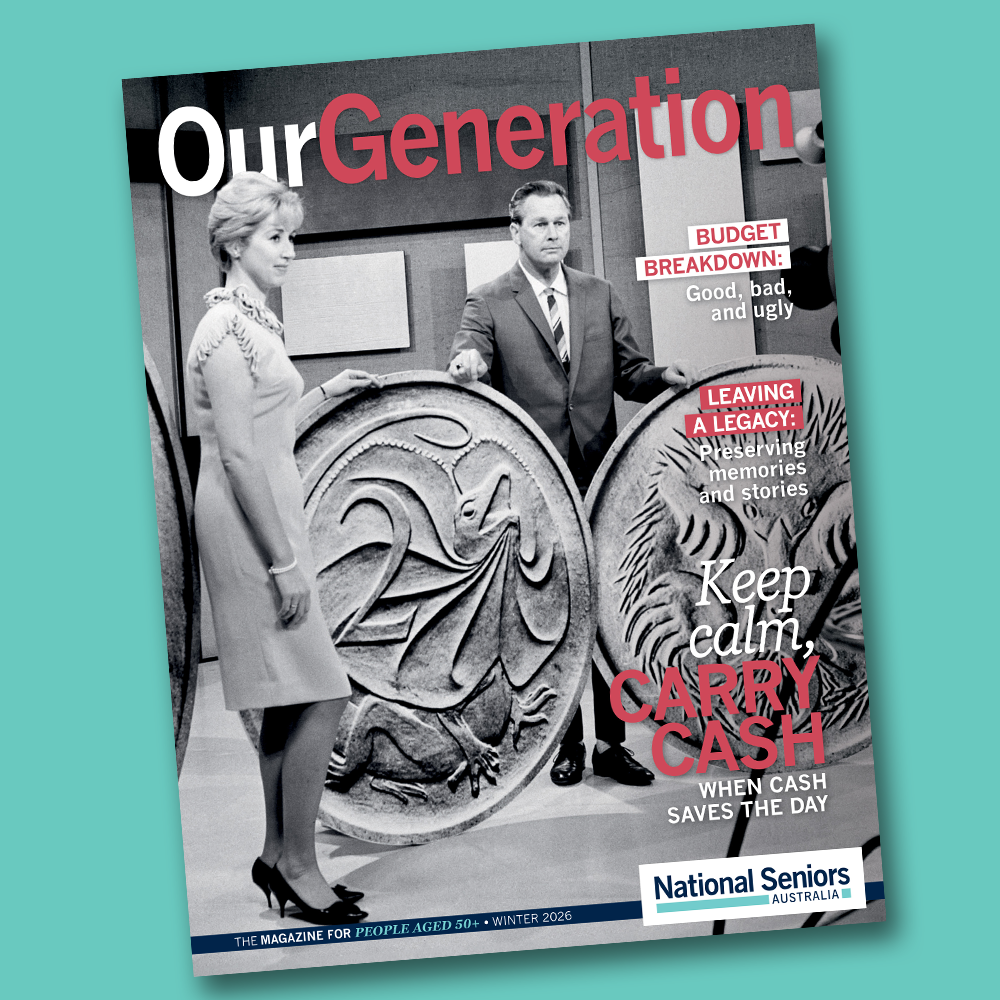
This article is featured in National Seniors Australia’s quarterly member magazine, Our Generation.
Become a member today and receive a yearly subscription to Our Generation digital magazine as part of your membership, along with exclusive discounts, competitions, branch access and more!
Your membership directly funds our advocacy and research work that benefits older Australians including fixing pension poverty, tackling health care costs, and improving aged care.

Creating a better future for older Australians
National Seniors Australia is a not-for-profit organisation dedicated to improving the lives of older Australians.
Through strong advocacy and community engagement, we work to create better outcomes in areas that matter most.
Our advocacy covers issues such as the cost of living, aged care, better housing, health costs, and pension poverty, and you can get involved
Explore our advocacy campaigns, submissions, and campaign wins to see the impact we've made, thanks to people like you.
Your support drives change.