Pets mean more to us than health and independence
NSA research published in the journal Anthrozoös highlights the ethical and altruistic meanings of pets to older Australians.

Pets have at least 36 distinct meanings to older people, a new NSA research report has shown.
The finding was based on responses to the 2024 National Seniors Social Survey (NSSS) and was published in the international peer-reviewed journal Anthrozoös.
The survey had invited participants with pets to “tell us about them and what they mean to you”, and 1,615 of the 5,106 participants wrote a comment doing so.
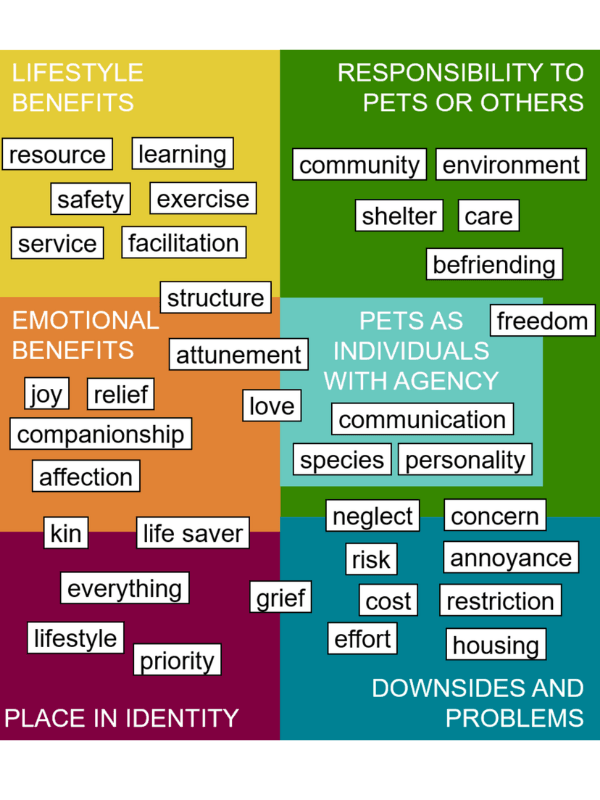
Our analysis of the comments boiled them down to the whopping 36 themes, which you can see summarised in the accompanying image.
The themes include several new ones that researchers haven’t written about before.
Ours is a very large study compared with other qualitative research about pets and older people, which may be why we were able to detect so many themes among the comments.
We invited University of Melbourne anthropologist, Dr Rachel Morgain, to co-author the paper with us because of her expertise on how anthropologists theorise relationships between humans and non-human animals.
Pets’ meanings for health and independence
The 36 meanings we detected among the 1,615 comments include pet benefits you might expect, such as encouraging us to exercise, facilitating social encounters with our fellow humans, or relieving our loneliness with companionship (you can see these underlined theme names in the diagram).
The themes also included downsides such as the cost and effort of pet care, or concern about what will happen to pets after we die or if we have to move and can’t take them with us.
Previous research about older people and pets has tended to focus on these very practical aspects of how pets can benefit or hinder their owners’ health and independence.
The presence of these meanings in our dataset confirmed that our research was on the right track because it reproduced themes other researchers had already described.
However, previous researchers have tended to stop at this rather narrow set of concepts when considering pets’ meanings.
In reality, we older people are complex human beings and pets mean more than that to us.
Ethics and altruism have meaning too
Our survey results showed that older people find meaning in other aspects of pet ownership, too – aspects that previous researchers haven’t identified as meaningful for us.
Three of the new meanings of pets we identified were each mentioned by over 100 respondents, suggesting a high level of importance to older people.
These became the focus of our paper because of their novelty in the research world.
The first, which we labelled shelter, included 154 comments about adopting rescue pets, looking after strays, or getting involved in other animal welfare activities.
Example comments included:
“Four feral cats found me and adopted me.”
“I foster end of life dogs that are not adoptable.”
“I’m involved with animal rescue groups as a volunteer.”
But it isn’t just pets who need help.
The second meaning we identified, named community, came from 129 comments about altruistically caring for other people’s pets or sharing care among different households.
Comments included:
“Inherited neighbour’s cat when she was admitted to nursing home.”
“Dog - was my mum’s dog but she passed last year, and I promised to look after her.”
“We have our neighbours’ dog and cat over once a week and mind the dog when the neighbours go away.”
“It is my son’s dog, which lives with me, as my son is a FIFO worker.”
These kinds of ethical and altruistic meanings of pets haven’t rated as important in the research world before.
A few researchers have mentioned in passing if an older person has a rescue pet, but they haven’t attributed any special meaning to this.
Yet the number of times such scenarios were mentioned by NSSS respondents shows they are a big deal for many older Australians.
It’s clear from comments that adopting a rescue, taking on a loved one’s pet, or sharing care of an animal is a matter of pride and principle to many of us and represents a meaningful way of making the world a better place.
Wondering at the universe
Personality was the third novel meaning we identified, based on 169 comments in which people described their pet’s unique characteristics and personality traits, just as they might describe a human.
Comments of this sort included:
“He’s more trustworthy and caring than most people.”
“Cranky old girl bit like me.”
“The lazy, not-needy type.”
Many pet owners make comments like this all the time in everyday life or use other adjectives to describe them (“beautiful”, “smart”, “anxious”), but researchers have not previously highlighted this as important to older people.
Yet appreciating and wondering at an animal’s unique traits and personality quirks is a meaningful part of life for many of us.
Our pets aren’t “just a pet” – they are living beings with whom we share a life. They are both different and similar to us and this makes them endlessly interesting and wondrous.
Other anthropological research tells us altruistic attitudes and self-transcendent appreciation of the world around us contribute to human beings’ life-satisfaction and general wellbeing.
This applies to older people as much as to anyone else.
The role of pets in promoting these less discussed aspects of later-life wellbeing has to be considered when thinking about how our society supports older Australians – whether through government policies on housing, aged care, income support, or anything else.
For example, our survey participants in past years have often called for pet-friendly policies in retirement living and aged-care homes.
Our wellbeing isn’t just about physical fitness, relief from loneliness, and money in the bank.

A rare peer-reviewed paper for NSA
While the findings of this research project are the most important take-home message here, we also want to take a moment to celebrate the achievement of publishing this in the journal Anthrozoös.
Publishing in peer-reviewed venues was a career requirement for us as researchers in our previous work as university academics, and both of us put our research through peer-review many times before as has our co-author Dr Morgain.
For Lindy this paper is a special milestone as it represents the 50th peer-reviewed paper of her career.
However, the in-house NSA research team has only rarely published NSSS research in peer-reviewed journals before in all its years of existence.
We have presented a few conference papers and posters based on NSSS results in recent years, for which our abstracts were subjected to peer review before acceptance. This has been important for getting our findings in front of other researchers, policymakers, and campaigners, and passing a partial peer-review process like that is a testament to the quality of our work.
But publishing in an international journal is considered to be the gold standard of publishing in most of the academic world, and in this case, as is standard for journals, it was the entire paper that was subject to peer-review not just the abstract.
We always strive for research excellence wherever we publish our work, so it is affirming that our work passed muster in a peer-reviewed journal.
Even more affirming is the fact that it is in a journal that ranks in the top quartile of anthropology journals worldwide.
If you’re interested in reading more about peer review, why it matters to researchers, and why we generally don’t go down that path at NSA despite its importance, we have an accompanying article covering those topics.
Read the pets paper here
One of the reasons we don’t usually publish in peer-reviewed journals is the timeframe – in this case, it has been two years between conducting the survey and publishing the paper.
That sort of timeframe is usually out of the question for NSA because our work needs to respond to current events and policy debates, so is funded by government for a shorter turnaround of results.
Another reason is the paywall problem – most journals block access to readers unless the authors pay an ‘open access’ fee of several thousand dollars to permanently unlock the gate (currently A$5,570 for a paper in Anthrozoös), or each reader can pay an access fee (currently US$56 for one paper in Anthrozoös).
Unfortunately, that is also the case for this paper as NSA could not afford the open-access fee, so there are restrictions on how we can distribute the paper.
However, we want you to be able to read our research for free since the NSSS and our salaries are paid for by government funds and NSA membership fees, so the work belongs to our community not just universities with journal subscriptions.
Luckily, we do have a workaround.
As authors we are allowed to offer unlimited copies of the accepted version of the paper on our personal websites, so we have uploaded a copy of it to Lindy’s old academic blog here.
The document looks like an ordinary Microsoft Word document not like a pretty published paper, but the content is the same, so you are getting all the information you need aside from the official page numbers.
If you will need the published version with page numbers for your own work, we do have access to a limited number of copies. Please email us at research@nationalseniors.com.au if that is the case and let us know your situation.
Or of course, if you are so inclined, you can pay for the published version at the journal website at any time.
We hope you enjoy reading the work as much as we enjoyed creating it.



Thousands of Australia-wide discounts
Exclusive offers and savings across dining, shopping, gift cards, and more – all in the EAT | PLAY | SAVE app.

Members save 10% on Travel Insurance*
National Seniors members receive a 10% discount on travel insurance policies*.

Financial Information Consultant
Speak to a real person and receive up-to-date information on retirement planning, superannuation, and more!
Branches
Expand your social circle, enjoy social events, day trips, guest speakers, and meet like-minded members.
Exclusive Travel Discounts
Save on tours, cruises, and holidays with exclusive discounts on National Seniors Travel.
Our Generation Digital Magazine
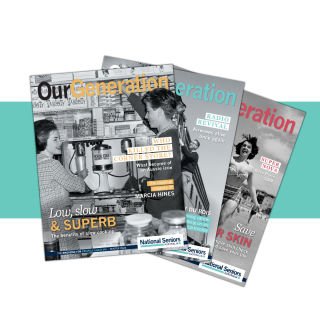
Receive a yearly subscription to Our Generation Digital Magazine.

The Good Guys Commercial
Members enjoy exclusive access to The Good Guys Corporate Benefits. Save on small and large appliances as well as technology.
Advocacy & Research
Your membership directly funds our advocacy and research work fighting issues that affect you.

Competitions
Access exclusive member-only weekly competitions including books, DVDs, CDs, movie tickets and more.

Discounts
In addition to the discounts app, members can save thousands on eGift Cards and other discounted products.
*The discount applies to the total National Seniors travel insurance premium and is for National Seniors Australia members only. Discounts do not apply to the rate of GST and stamp duty or any changes you make to the policy. AGA has the discretion to withdraw or amend this discount offer at any time. This discount cannot be used in conjunction with any other promotional offer or discount.
National Seniors Australia Ltd ABN 89 050 523 003, AR 282736, is an authorised representative of AWP Australia Pty Ltd, ABN 52 097 227 177, AFSL 245631, trading as Allianz Global Assistance (AGA), and acts as AGA's agent and not as your agent. nib Travel Services (Australia) Pty Ltd (nib), ABN 81 115 932 173, AFSL 308461 acts as third party administrator on behalf of AGA, managing claims, complaints, enquiries and sales. This is general advice only. Before you buy, you should consider whether the product is appropriate for you, the Product Disclosure Statement (PDS), Financial Services Guide (FSG) and Target Market Determination (TMD) is available from us. This insurance is underwritten by Pacific International Insurance Pty Ltd, ABN 83 169 311 193, AFSL 523921.